วันศุกร์ที่ 18 ธันวาคม พ.ศ. 2558

Chess prodigy Magnus Carlsen: 'Bobby Fischer is my dream opponent'


(CNN)Magnus Carlsen is used to breaking records. At 13 he became the world's youngest chess grandmaster. Six years later, at the age of 19, the baby-faced Norwegian was named the World No. 1 -- again, the youngest player to hold the title.
Now 25-years-old, the international poster boy of chess might have been one of the youngest players at the prestigious 2015 London Chess Classic -- but that clearly wasn't going to stop him taking home the trophy on Sunday.
We sat down with the chess genius, asking him questions posed by YOU using the hashtag #AskMagnus. And we were inundated with questions from the public -- everything from Carlsen's eating habits to his ultimate opponent.

Here are some of the answers:

Magnus Carlsen: "Probably Bobby Fischer at his best. Because the precision and energy that he played with is just unmatched in the history of chess. So Bobby Fischer from 1970 to 1972."
MC: "Usually a salad or an omelet to get some energy. Something that's not too heavy."
MC: "I think there are many cultural reasons. Chess has generally been a man's game and thus more men start playing chess -- so the numbers are much greater.
"I think the chess community could be better at including girls and women in chess. Because sometimes for a very young girl, it's not the easiest community to get into."
MC: "Computers are here to stay, obviously. But I consider myself, at least stylistically, part of the old generation. I feel that I have more in common with the players who are 35 to 40 now, then the ones who are a few years younger than I am.
"I think computers have evened out the playing field but it is not very good for the creativity in chess. Computers have definitely pushed the theory along, which is interesting from a purely scientific viewpoint. But from a sportsman's viewpoint, and also from an artist's viewpoint, it's not helped."
MC: "Most of the time the variations that are most relevant are four or five moves ahead, because for the next four or five moves you can calculate every reasonable possibility.
But if it goes much further the possibilities are too diverse and it's just too time-consuming. And also the probability of mistakes are very high.
But if the position is simple, then I can calculate as many moves as I want."
MC: "All games between beginners are decided on pieces being blundered on almost every move. So I guess the most useful thing is just do exercises -- which pieces can you capture in this particular position?
"And learn some basic checkmating patterns. Because even if you capture all of your opponent's positions, you need to learn how to checkmate, otherwise you'll probably end up stalemating your opponent all the time."
MC: "Probably Kasparov when he was young -- pre-1984."
MC: "It's hard to pinpoint one. There are several players who I find it difficult to play against. Probably the most difficult is [World No. 6] Levon Aronian.
"I have a pretty good score against him, but he's probably outplayed me more times than anyone else at the top."
MC: "I don't know about right now, because right now I'm not playing particularly well. But I think me at my best versus Garry at his best would be very interesting. I think I would have a fair chance of winning -- but I would be pushed to the limits in every game, by the sheer power and energy in his playing.
"As for Bobby Fischer, I think I'd probably have a good chance to beat him. But you never know."

The questions kept rolling in on Facebook too...

How many hours do you practice chess a day? #AskMagnus -- René Leon Colmenares
MC: "I never had a schedule, never really liked being told what to do in chess or in school.
"So my first trainer would sometimes give me some homework that I wouldn't really like -- sometimes I'd do it, sometimes I wouldn't. But then instead I might have thought about some chess problems in my hea or read a chess book or just moved the pieces around a bit on my own.
"And I think it was just as useful training in the long run. So basically the answer is each day -- not very much. But I think about chess all the time, I read about chess all the time."
What is your favorite chess book and favorite non-chess book? #AskMagnus -- Matthew Thompson
MC: My favorite chess book, from when I was 10 or 11, was probably a book of Vladimir Kramnik's games -- he's actually been one of my main opponents for some years now. But I really liked the style he played when he was young.
"Non chess book? It's a little book I read all the time from four to five years old. It's a little book of all the flags in the world -- including population, area, all the municipalities, counties in Norway, all the data."
What was your childhood like? Do you have time for friends? #Ask Magnus -- Jaakko Kauranen
MC: "As a child I was pretty active -- I used to play football, skiing in the winter, very much liked hiking in the mountains with the family.
From when I was eight I would go to school, then play football with my friends, go home, do some homework, do some chess stuff, and still I would find time to hang with my friends.
I guess there was just very little idle time, I didn't play computer games or things like this. I was very active in general."

Mommie Dearest

Pope Francis will make Mother Teresa—a fanatic, a fundamentalist, and a fraud—a saint.

SAPA970313302560
Thomas Cheng/AFP/Getty Images
In 2003, Pope John Paul II approved the beatification of Mother Teresa. At the time, Christopher Hitchens called Mother Teresa “a fanatic, a fundamentalist, and a fraud,” arguing that “even more will be poor and sick if her example is followed.” On Friday, Pope Francis announced that he will make Mother Teresa a saint in 2016. Hitchens’ original essay is republished below. 

I think it was Macaulay who said that the Roman Catholic Church deserved great credit for, and owed its longevity to, its ability to handle and contain fanaticism. This rather oblique compliment belongs to a more serious age. What is so striking about the "beatification" of the woman who styled herself "Mother" Teresa is the abject surrender, on the part of the church, to the forces of showbiz, superstition, and populism.
It's the sheer tawdriness that strikes the eye first of all. It used to be that a person could not even be nominated for "beatification," the first step to "sainthood," until five years after his or her death. This was to guard against local or popular enthusiasm in the promotion of dubious characters. The pope nominated MT a year after her death in 1997. It also used to be that an apparatus of inquiry was set in train, including the scrutiny of an advocatus diaboli or "devil's advocate," to test any extraordinary claims. The pope has abolished this office and has created more instant saints than all his predecessors combined as far back as the 16th century.
As for the "miracle" that had to be attested, what can one say? Surely any respectable Catholic cringes with shame at the obviousness of the fakery. A Bengali woman named Monica Besra claims that a beam of light emerged from a picture of MT, which she happened to have in her home, and relieved her of a cancerous tumor. Her physician, Dr. Ranjan Mustafi, says that she didn't have a cancerous tumor in the first place and that the tubercular cyst she did have was cured by a course of prescription medicine. Was he interviewed by the Vatican's investigators? No. (As it happens, I myself was interviewed by them but only in the most perfunctory way. The procedure still does demand a show of consultation with doubters, and a show of consultation was what, in this case, it got.)
According to an uncontradicted report in the Italian paper L'Eco di Bergamo, the Vatican's secretary of state sent a letter to senior cardinals in June, asking on behalf of the pope whether they favored making MT a saint right away. The pope's clear intention has been to speed the process up in order to perform the ceremony in his own lifetime. The response was in the negative, according to Father Brian Kolodiejchuk, the Canadian priest who has acted as postulator or advocate for the "canonization." But the damage, to such integrity as the process possesses, has already been done.
During the deliberations over the Second Vatican Council, under the stewardship of Pope John XXIII, MT was to the fore in opposing all suggestions of reform. What was needed, she maintained, was more work and more faith, not doctrinal revision. Her position was ultra-reactionary and fundamentalist even in orthodox Catholic terms. Believers are indeed enjoined to abhor and eschew abortion, but they are not required to affirm that abortion is "the greatest destroyer of peace," as MT fantastically asserted to a dumbfounded audience when receiving the Nobel Peace Prize.* Believers are likewise enjoined to abhor and eschew divorce, but they are not required to insist that a ban on divorce and remarriage be a part of the state constitution, as MT demanded in a referendum in Ireland (which her side narrowly lost) in 1996. Later in that same year, she told Ladies’ Home Journal that she was pleased by the divorce of her friend Princess Diana, because the marriage had so obviously been an unhappy one …
This returns us to the medieval corruption of the church, which sold indulgences to the rich while preaching hellfire and continence to the poor. MT was not a friend of the poor. She was a friend of poverty. She said that suffering was a gift from God. She spent her life opposing the only known cure for poverty, which is the empowerment of women and the emancipation of them from a livestock version of compulsory reproduction. And she was a friend to the worst of the rich, taking misappropriated money from the atrocious Duvalier family in Haiti (whose rule she praised in return) and from Charles Keating of the Lincoln Savings and Loan. Where did that money, and all the other donations, go? The primitive hospice in Calcutta was as run down when she died as it always had been—she preferred California clinics when she got sick herself—and her order always refused to publish any audit. But we have her own claim that she opened 500 convents in more than a hundred countries, all bearing the name of her own order. Excuse me, but this is modesty and humility?
The rich world has a poor conscience, and many people liked to alleviate their own unease by sending money to a woman who seemed like an activist for "the poorest of the poor." People do not like to admit that they have been gulled or conned, so a vested interest in the myth was permitted to arise, and a lazy media never bothered to ask any follow-up questions. Many volunteers who went to Calcutta came back abruptly disillusioned by the stern ideology and poverty-loving practice of the "Missionaries of Charity," but they had no audience for their story. George Orwell's admonition in his essay on Gandhi—that saints should always be presumed guilty until proved innocent—was drowned in a Niagara of soft-hearted, soft-headed, and uninquiring propaganda.
One of the curses of India, as of other poor countries, is the quack medicine man, who fleeces the sufferer by promises of miraculous healing. Sunday was a great day for these parasites, who saw their crummy methods endorsed by his holiness and given a more or less free ride in the international press. Forgotten were the elementary rules of logic, that extraordinary claims require extraordinary evidence and that what can be asserted without evidence can also be dismissed without evidence. More than that, we witnessed the elevation and consecration of extreme dogmatism, blinkered faith, and the cult of a mediocre human personality. Many more people are poor and sick because of the life of MT: Even more will be poor and sick if her example is followed. She was a fanatic, a fundamentalist, and a fraud, and a church that officially protects those who violate the innocent has given us another clear sign of where it truly stands on moral and ethical questions.
Correction, Oct. 21, 2003: This piece originally claimed that in her Nobel Peace Prize lecture, Mother Teresa called abortion and contraception the greatest threats to world peace. In that speech Mother Teresa did call abortion "the greatest destroyer of peace." But she did not much discuss contraception, except to praise "natural" family planning.

Pope Francis recognises second Mother Teresa 'miracle'


  •  
  • From the sectionIndia
Mother TeresaImage copyrightGetty Images
Image captionMother Teresa was awarded a Nobel Peace Prize for her work with the poor in Kolkata
Pope Francis has recognised a second miracle attributed to Mother Teresa, clearing the way for the Roman Catholic nun to be made a saint next year.
The miracle involved the healing of a Brazilian man with several brain tumours in 2008, the Vatican said.
Mother Teresa died in 1997 and was beatified - the first step towards sainthood - in 2003.
She won the Nobel Peace Prize for her work with the poor in the slums of the Indian city of Kolkata (Calcutta).
"The Holy Father has authorised the Congregation for the Causes of Saints to proclaim the decree concerning the miracle attributed to the intercession of blessed Mother Teresa," the Vatican said on Friday.
She is expected to be canonised in Rome in September.
Sister Christie, a spokesperson for the Missionaries of Charity Mother Teresa founded in 1950, told the BBC that they were delighted by the news.
"Obviously all of us at the Missionaries of Charity are extremely happy. But we do not have any plans to celebrate this announcement as yet," she said.

'Saint of the gutter'

Beatification by the Catholic Church requires one miracle, while the process of becoming recognised as a saint requires proof of at least two miracles.
Mother Teresa was beatified in 2003 after Pope John Paul II accepted as authentic a miracle attributed to her.
He judged that the curing of an Indian woman suffering from an abdominal tumour was the result of the supernatural intervention of the late Mother Teresa - a claimchallenged by Indian rationalists.
There are few details about the recovery of the Brazilian man, whose life the Vatican says was saved in the second miracle.
His identity has not been disclosed to maintain the discretion needed for the investigation, the Catholic New Agency has said.
It says he was unexpectedly cured from brain tumours in 2008 after his priest prayed for Mother Teresa's intervention with God.
Born Agnes Gonxhe Bojaxhiu in Skopje, Macedonia, in 1910, she dedicated her life to caring for impoverished and sick people in Kolkata.
Known as the "saint of the gutter", she earned worldwide acclaim for her efforts.
Her critics, however, accused her of peddling a hardline Catholicism, mixing with dictators and accepting funds from them for her charity.
Her supporters justified the funding, saying it did not matter where the money came from as long as it was used to help the poor.

วันพุธที่ 9 ธันวาคม พ.ศ. 2558

Reindeers are so uniquely adapted to the dark Arctic winter, they are more likely to overheat than freeze in the cold
Reputation: Reindeer have red glowing noses and live in an unforgiving environment where food is hard to find in the winter, and where keeping warm is a major challenge
Reality: Reindeer, with one notable exception, don't have red noses. But they do have pretty sophisticated heat exchangers inside their snozzles. They also have plenty to eat through the Arctic winter. And their coats are so warm and thick that they are more likely to overheat than freeze
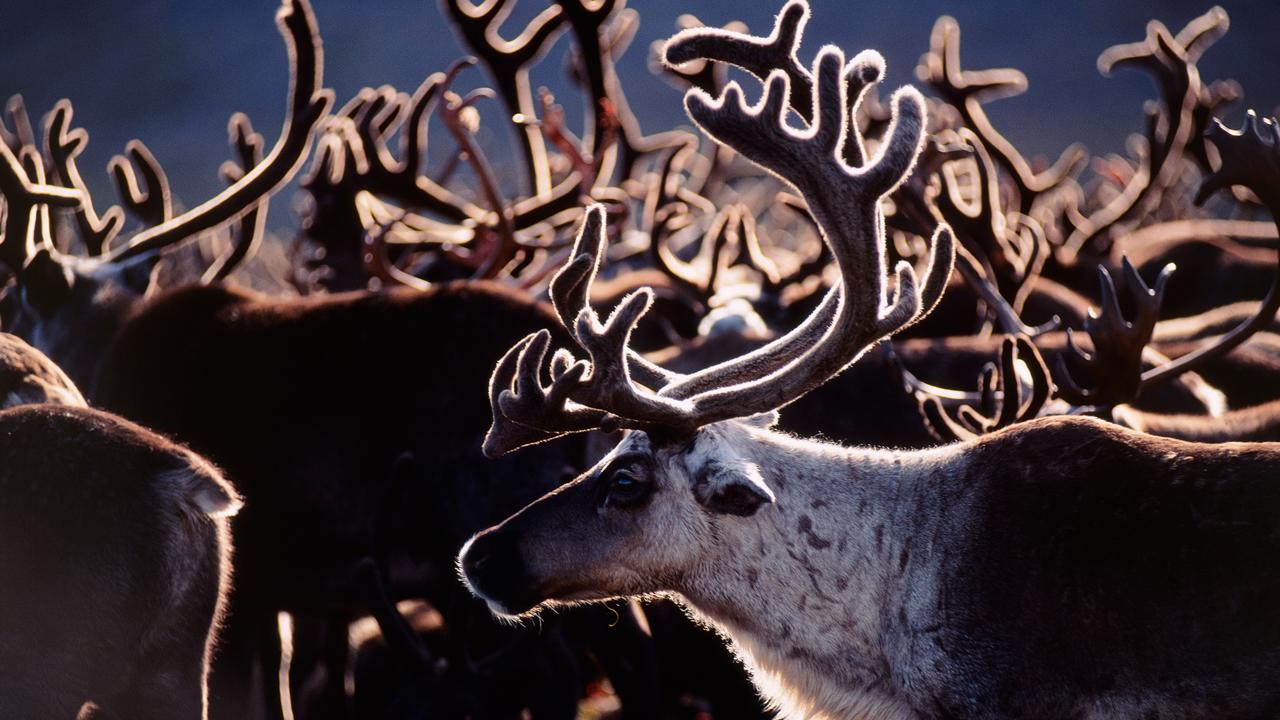
Special schnozzles (Credit: Staffan Widstrand/NPL)
This time of year, reindeer get a lot of airtime. But beyond their role as the seasonal sleigh-pullers of cards and carols, reindeer are iconic animals of the North – perfectly adapted for a life of extremes.
“It is often reported that these animals live a knife edge existence in the cold, dark north,” says Nicholas Tyler of the Centre for Sami Studies at the University of Tromso, Norway. When he first began his reindeer research in the 1970s, the prevailing thought was that “the Arctic was a terrible place, and plants and animals living in the Arctic were hanging on by their toes”.
What's emerged in the past 35 years of research is an understanding that “the overwhelming majority of all individuals of all the Arctic species go through winter warm and well fed”, says Tyler.
The reindeer – Rangifer tarandus – is a perfect example.
Reindeer “are beautifully adapted”, says Tyler, who has spent decades studying them in Svalbard, the isolated archipelago between mainland Norway and the North Pole.
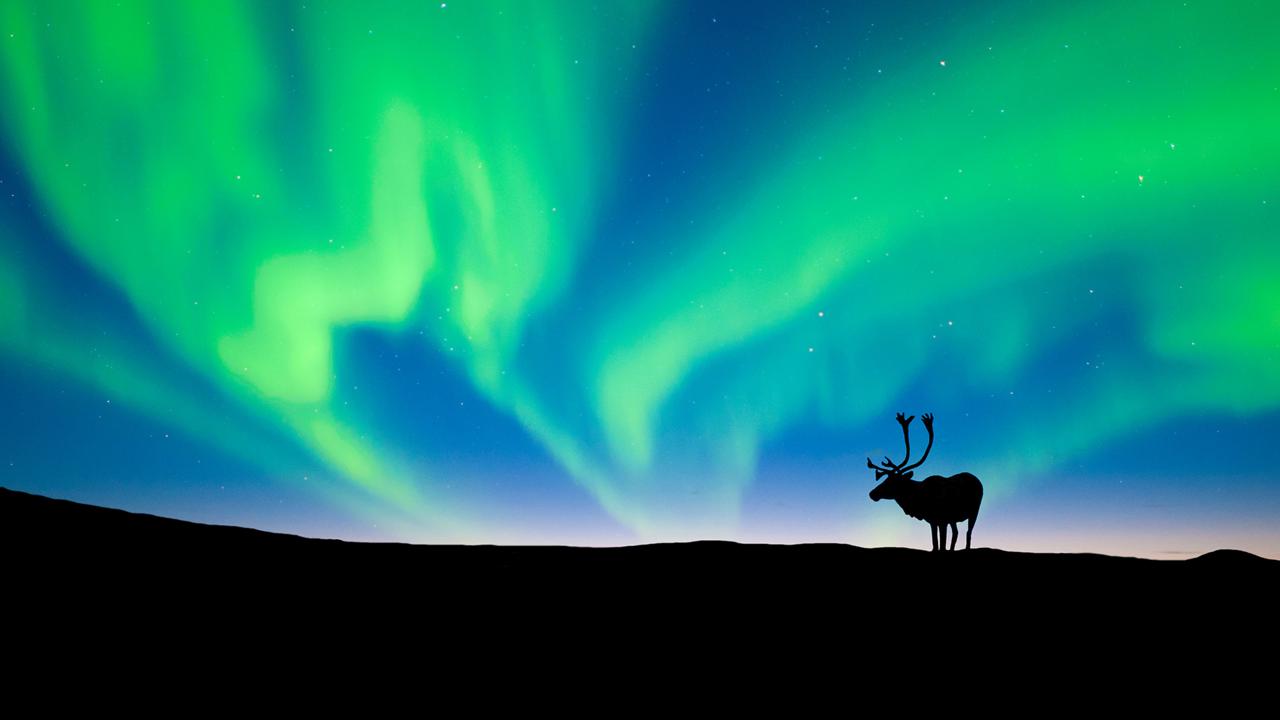
A reindeer basks in the Northern Lights (Credit: AlamySP)
Reindeer coats are incredibly insulating, he explains.
Each year, they shed their thick winter coat for a short summer one. So, explains Tyler, it's only in summer – when Svalbard temperatures can dip to 1C – that this population of reindeer may occasionally be cold.
To avoid overheating, reindeer are able to flush their legs with blood
But being cold in summer is unlikely in many parts of their range. In Northern Canada, reindeer – more often called caribou – seldom have time to get cold. Here, herds of the animals are almost constantly moving in a near-futile attempt to dodge pursuit by mosquitoes.
In fact, when it comes to the cold, the reindeer’s challenge is often the reverse of what you might expect. As humans, we evolved in tropical climes, and when naked, we must ramp up our metabolism to stay warm if the temperature dips below 25C.
For reindeer, explains Tyler, that lower critical temperature is a bone-chilling -40C.

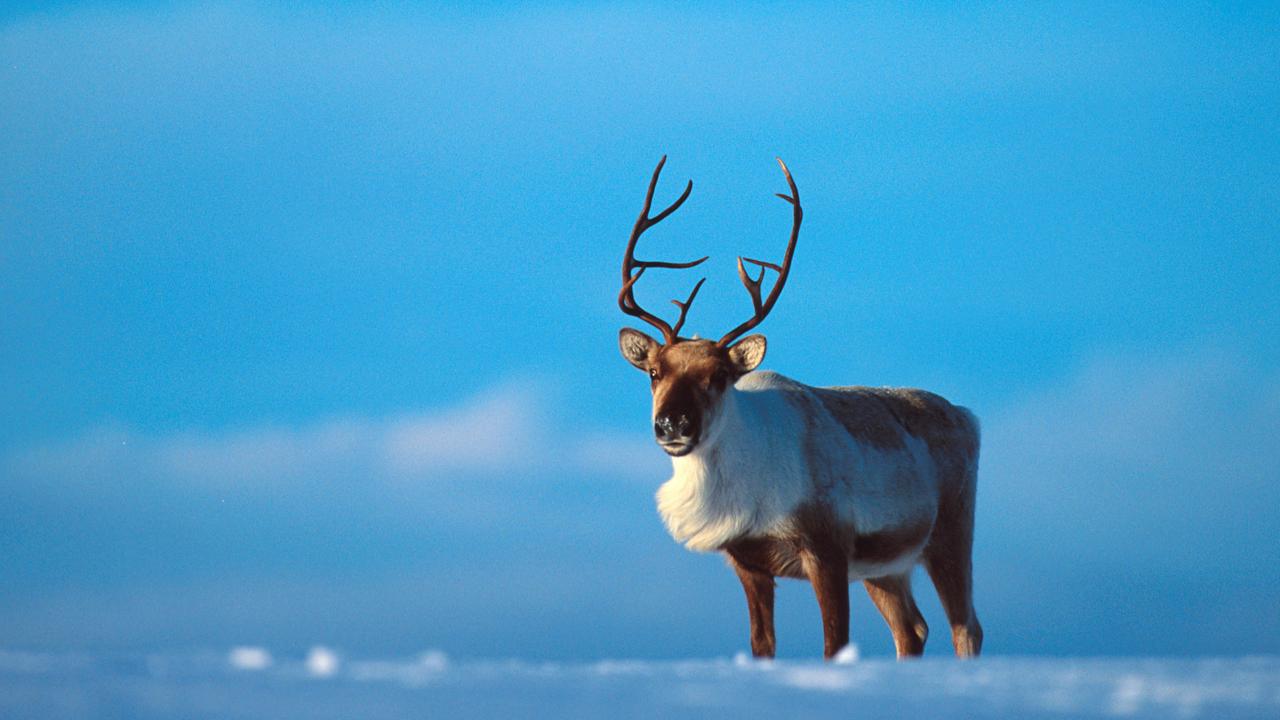
Keeping warm isn't hard for reindeer (Credit: Wonders of Europe Munier/NPL)
So well insulated is the reindeer in winter that for an individual trotting along with a wolf on its tail, it’s analogous to us “jogging with a down jacket on”, says Tyler. Their problem is getting rid of the heat. As a result, the reindeer has some clever adaptations for heat loss and heat conservation.
When it comes to the cold, the reindeer’s challenge is not overheating
To avoid overheating, reindeer are able to flush their legs with blood. And by training reindeer to run on treadmills, University of Tromso researcher Arnoldus Blix and colleagues discovered that reindeer can also cool down by panting like dogs, evaporating water from their large tongues.
As for the noses of wild reindeer – unlike Rudolph’s, they are not red. But, says Tyler, they “are immensely complicated”.
In winter, if it’s -30C outside, breathing humans appear to have steam coming out of their noses. For reindeer standing at rest in that very same cold air, “there isn’t any steam coming out of its nose”, he explains.
Air leaves human noses at about 32C, explains Tyler, with the water it contains condensing into visible water droplets as warm air meets cold. Reindeer have amazing heat exchangersinside their schnozzle, wherein warm air is cooled down by about 21C before it’s vented outside, saving the majority of that heat.
The reindeer nose cools warm air by about 21C before it’s vented outside
Their noses are versatile too. A reindeer can put the whole system into reverse to dump heat, says Tyler, “like when it’s running from a wolf”.
So with reindeer, evolution has provided some incredible solutions to the cold.
But how do they cope with the almost continuous darkness of the Arctic winter?
Some eye-opening truths have recently emerged.
Reindeer (Credit: Asgeir Helgestad/NPL)
Reindeer eyes need to cope with the near-absence of the sun in winter, and two to three months of almost continuous daylight in summer. So it’s not just their coats that change between seasons. Reindeer eyes change too.
Glen Jeffery, at the Institute of Ophthalmology at the University of London, UK, had no particular interest in reindeer until Norwegian biologists sent him some eyes harvested from reindeer killed at the summer and winter solstices.
A warmer climate is probably the least of the reindeer’s worries
Jeffery opened them up to take a look and discovered a radical difference between seasons.
In summer, the reflective surface behind the retina was golden, like the yellow “cat eye” shade seen reflected from the eyes of many non-human mammals that are active at night. Jeffery’s surprise was that in winter, the same part of the reindeer eye was a very deep blue. “No one had ever heard of an animal changing the reflection from behind its eye between seasons,” says Jeffery.
Turns out, “by turning the back of the eye blue, what the animal was doing was letting less light escape from its eye, and increasing visual sensitivity”, says Jeffery.
With reindeer winter eyes able to see into the ultraviolet spectrum, it likely enhances the contrast.
In winter, the ground is snow-covered, and reindeer need to forage to find food. When a piece of lichen – a reindeer favourite – sticks out through the snow, that lichen absorbs UV, while the snow reflects UV.
Human technologies can mess with reindeers' eyes (Credit: imageBROKER/AlamySP)
“So instead of it being green on a white background, for the animal it’s probably a very, very dark grey or black on a white background.” The advantage of these amazing winter-adapted eyes, says Jeffery, is that “it increases contrast in an environment where contrast is very much reduced”.
While their winterised eyes are beneficial in the natural environment, Jeffery and colleagues are discovering that artificial environments may pose new reindeer challenges.
Power lines, for example, “give off UV flashes”, says Jeffery, which inhibits reindeer habitat use along transmission corridors. Artificial light near human habitation may also impede the annual winter adaptation of their eyes, leaving them in the visual equivalent of “a halfway house”, explains Jeffery.
When it comes to wild and aboriginally herded reindeer, the future is unclear. Infrastructure like roads, dams, and power lines have eroded vast tracts of reindeer grazing areas, says Tyler, making adaptation to a warmer climate probably “the least of their worries”.
Lesley Evans Ogden is on Twitter @ljevanso

วันอังคารที่ 8 ธันวาคม พ.ศ. 2558

New Discovery Solves One Mystery of Stonehenge’s Construction

Tools, a quarry, and a sunken road say a lot about Stonehenge. They also raise new questions for archaeologists.
Picture of Sunset at Stonehenge on the Salisbury Plain of Wiltshire in Southern England
Researchers believe they've found the origin of some of the stones that make up Stonehenge.

New findings from a team of British archaeologists shed light on how some of Stonehenge’s monoliths were extracted and transported.  
In an announcement Monday, the team said it found extensive evidence of Neolithic stone quarrying at two sites in Wales that supplied the distinctive ‘bluestones’ erected at Stonehenge around 5,000 years ago. Forty-three bluestones survive out of an estimated 80 that once stood at Stonehenge; they form an inner horseshoe at the site, surrounded by the outer circle of much larger giant sandstone monoliths. By dating and studying artifacts from the quarries, the archaeologists have determined when and how prehistoric people first extracted these bluestones.  
The Welsh quarries are located in the Preseli hills in north Pembrokeshire, roughly 180 miles (290 km) from from Stonehenge by land. The bluestones weigh 1-2 tons and are up to 8 feet tall.

The stones are volcanic and igneous rocks with precise geological signatures that match the inner horseshoe of smaller rocks at Stonehenge. Geologists have shown that this region of Wales is the only part of the British Isles that contains a particular type of rock—spotted dolerite—common in the bluestones. 
You Might Also Like
Archaeologists have uncovered stone tools, dirt ramps and platforms, burnt charcoal and chestnuts, and an ancient sunken road that was likely the exit route from the quarry. “While we knew the locations where the rocks originated, the really exciting thing was to find actual quarries,” says Mike Parker Pearson, director of the project and a professor at University College London. “They built extensive facilities here: platforms, ramps, a loading bay. You can see chisel marks where they drove in wooden wedges at the recesses on the outcrop.” 
Radiocarbon dates from charcoal and burned hazelnuts at prehistoric campfires show Neolithic activity at the quarries between 5,400 and 5,200 years ago. Researchers believe that Stonehenge was not built before 5000 BC. This raises a puzzling question: where were the stones during those 400 years?  

“It’s intriguing,” Parker Pearson says, “and while it could’ve taken those Neolithic stone-draggers nearly 500 years to get them to Stonehenge, that’s pretty improbable. It’s more likely that the stones were first used in a local monument somewhere near the quarries that was then dismantled and dragged off to Wiltshire.” Locating and studying the site of this possible local monument will be a primary research goal for the team in 2016.  

Moving Two-Ton Monoliths

Naturally forming rock pillars at the quarry sites made things somewhat easier for the prehistoric workers. “They only had to insert wooden wedges into the cracks between the pillars and then let the Welsh rain do the rest by swelling the wood to ease each pillar off the rock face,” says Dr. Josh Pollard of the University of Southampton. “The quarry-workers then lowered the thin pillars onto platforms of earth and stone, a sort of ‘loading bay’ from where the huge stones could be dragged away along trackways leading out of each quarry.” 

Eighty of the bluestone monoliths were eventually transported to Stonehenge. Moving two-ton monoliths across nearly 200 miles of countryside is an extraordinary undertaking, but examples from India show that stones this size can be carried on wooden lattices by groups as small as 60 people. 
Picture of Stonehenge quarries found 140 miles away in Wales
Archaeologists have long thought the bluestones in Stonehenge came from sites in Wales. Now they say they've found the precise source in two quarries in the Preseli hills in Pembrokeshire.
Removing the stones from the quarries required a combination of strength and ingenuity. The narrow width of the exit pathway—only 6 feet (1.8 m) across— is too small to accommodate the use of wooden rollers. Archaeologists believe that workers used a combination of ropes, levers, and a fulcrum to position the stones on top of wooden sledges that were carried or slid downhill. “You need two teams,” says Parker Pearson, “one on the top with a rope taking the strain and lowering it slowly and another, standing roughly 3 feet lower, ready to receive it.” 
Though the workers at the site likely ate a diet of mostly meat, no bones or antlers have survived because of the area’s highly acidic soil. What does survive is evidence of snacks on roasted chestnuts, a staple of the Neolithic diet. Parker Pearson thinks that a group of at least 25 workers did the quarrying, probably walking to the site each day from nearby settlements.  
If research over the next year reveals a local monument near the quarry where the bluestones were initially used, this could suggest that the builders of Stonehenge migrated from Wales. Deducing the purpose and function of the local monument might also solve long-standing mysteries about the role that Stonehenge played in the culture of prehistoric Britain. The research of Parker Pearson and his team was supported by a grant from National Geographic Science and Exploration. 

วันศุกร์ที่ 4 ธันวาคม พ.ศ. 2558

This man will be the next President of America (2017)

Donald Trump

In November, 2016, Americans will have two words for Donald Trump, "You're hired!"
Trump announced he was running for president this past June (2015) and he entered the race with unmatched name recognition, quickly catapulting him to the top of the polls.

His blunt talk and stance on major issues has kept him at the top of those polls, and there's been no slowing him down.
Trump is for real, and here are all the reasons why he'll be moving from an office in Manhattan into the Oval Office in January 2017...

Donald is a true political outsider. He's never run for office. When he says he's a Washington outsider, he's telling the truth. He considered runs for POTUS and for Governor of New York in the past, but ultimately chose not to throw his hat in the ring.
This means he's not influenced by any of the things political lifers are used to -- like lobbyists for big businesses, unions and corrupt organizations greasing his palms over their own special interests.
It's been a long time since the country has had a candidate with no political experience and solid ideas to make this country great again.
The last non-political candidate to do so was businessman H. Ross Perot, who ran in the 1992 election and again in 1996.

Trump has successfully led large corporations. Yes, anyone can lead a large corporation, but not everyone has the leadership quality The Donald has.

He doesn't only have business knowledge, but something more -- he knows how to set goals, create a vision and get positive results.
Even when he experiences a negative result in business, he has the leadership to turn things back around and make a profit. This is the same leadership America needs right now.

What you see is what you get from Donald. He's not trying to pretend to be something he's not just to win votes.

He says what's on his mind, and while that may offend some and impress others, everyone knows where he stands on every issue.

The reality show is one reason why Donald will win the presidency in 2016.
Americans observed his leadership and management styles on the show and understand how he works.

He delegated tasks to employees he trusted and took their advice about how well teams or individuals did. He motivated teams to do their best just so they wouldn't have to go into the boardroom and answer his tough questions.
Americans don't have to wonder how he'd lead the country. They've seen his leadership and management styles in action.
Trump has always been a champion for this country and stands to make no personal gain if he becomes president. He simply wants the best for this country.
He's never threatened to leave the U.S. or take his businesses or money to another country because of any policies if he didn't get his way -- like some other wealthy Americans and corporations.
Even in his speech announcing his run for president, Trump told supporters he was the candidate who could make the country great again.

The Republican Party would rather have another candidate leading in the polls.
The media can't figure him out and has failed to bring him down on numerous occasions when calling him out over his comments, which he then explains and seems to make a lot of sense.
Super-liberal NBC dumped him from "The Celebrity Apprentice" because of his stance on illegal immigration. They also said they'd no longer air the Miss Universe pageant or the Miss USA pageant, which he co-owned with the network.

So what did he do? He bought out NBC's 50 percent share of the pageant and became its sole owner. He sold it off three days later to William Morris Endeavor.
Experienced politicians just want him to go away.
But Trump doesn't care -- he's not running for president to please the media, his political party or career politicians. He's running for president to help the American people.
While many people running for the highest office would cower or become disenchanted, Trump won't be intimidated or bullied.
This type of personality is exactly what's needed in the White House.
In a crisis, he won't be intimidated by world leaders or American politicians wanting him to do the opposite of what he knows is right. He'll do what's right for America.

The majority of the Republican presidential candidates are focused on getting elected to help America, but also to fulfill a personal goal.
They aren't interested in telling America what they'd do to change the country for the better. Unfortunately, voters are used to this.
What they aren't used to is a candidate with personality, commitment and honest answers. Trump has energized Republicans interested in a real candidate with real answers to their issues.

The majority of the Republican candidates running for president will drop out of the race long before primary time.
It's not because they can't attract the big money donors -- they simply can't handle Trump.
Instead of running for president, they are focused on criticizing Trump and hoping he goes away. This isn't a good campaign strategy.

He's using his own money to run for president. According to Trump, he's worth more than $10 billion and he's willing to spend at least $1 billion of his own money to get elected.
No other presidential candidate is willing to self-finance his or her campaign to work for the people of the United States.
Trump even said he'd forego the $400,000 a year salary that comes with the job.

He's not the hard-core, right wing republican that liberal democrats and moderate republican’s voters are used to hating.
He actually has personal views on social issues that will make many democrats happy. He also has views on social issues that will make many republicans happy.
With social issues out of the way, he'll be able to work with both democrats and republicans on the important issues facing America.

Donald can't be swayed by sweet deals and lots of money. That's what the special interests like to do give to receive special favors.
Super PAC-funding billionaires can't influence him with money (he probably has more money than they do).
He has the guts to take on special interests and protect America from the failed policies that the lobbyists helped shape.

Donald is ready to take charge and do the work many presidents haven't done. He has a plan to fix immigration, create jobs and make American's enemies respect us again.

Additionally, he'll take care of our veterans and stop the one-sided trades with other nations.
For decades, Americans have lost jobs to overseas workers. As a successful businessman, Trump knows how to negotiate business deals.

He'll know how to bring jobs to the United States instead of letting them move or remain overseas.
Get ready America; the jobs you want are headed your way with Trump as president!

Huge egos actually get a bad rap -- especially for someone like Trump.
His ego will motivate him to do what he has to do to avoid failing and letting the American voters down. Besides, Trump plays to win, not to fail.

Donald is the type of leader who doesn't fear anyone. He will take on anyone -- and win.
While others bow down to foreign leaders as if they're superior to the U.S., let our rivals test us and make deals that will benefit our enemies, Trump doesn't fear his domestic political rivals or world leaders.

Donald is the type of leader who doesn't fear anyone. He will take on anyone -- and win.
While others bow down to foreign leaders as if they're superior to the U.S., let our rivals test us and make deals that will benefit our enemies, Trump doesn't fear his domestic political rivals or world leaders.

Yes he has a bombastic public persona, but he's also mastered the fine art of negotiating complex deals.
During his career, Trump has convinced investors, companies, industries and governments to do what he thinks is best via tough negotiations.
During debates he'll convince undecided voters and those supporting other candidates that he is right for the job as president.

Many libertarians and business people will support his bid for president because he supports free enterprise.
These voters know that he has their back when it comes to less government regulations and more free enterprise to help the American market grow and help small businesses prosper.

As a successful business leader, he's talked with and negotiated with a lot of and governments and business leaders around the world. He most likely has connections that give him insight into economics throughout the world that other candidates could only dream of having.
This will help him show America that he can pursue the right trade agreements and partnerships with different countries.
After the country hires Trump as president, he'll have two words for America, "You win!"

Trump is a winner. He's a great businessman. He's has great leadership qualities. He has a great commitment to this country's success, and as a result, President Trump will make America great again! And there's one more reason Trump would be a great president..