วันศุกร์ที่ 5 กุมภาพันธ์ พ.ศ. 2559

India's 'dead' car auctions: Where you can get a Porsche for $7,000

  • 5 February 2016
  •  
  • From the sectionIndia
A flood-damaged 2015 Jaguar at the car yardImage copyrightNATHAN G
Image captionM Prem Kumar picked up this flood-damaged 2015 Jaguar for $25,000 at the yard
In the middle of a sprawling yard lined with used cars, Jambu Kumar is hunting for a Mercedes Benz sedan.
The 29-year-old did not own a car until six years ago. His father, a pawnbroker, drove a scooter all his life. In 2009, Mr Kumar, who runs a small automobile spare parts business, bought a Skoda, becoming the first person in his family to own a car.
When Mr Kumar heard from friends that cars damaged in last year's deadly floods in the southern city of Chennai (Madras) were being auctioned, he drove down to the yard.
The car enthusiast is looking to pick up the Mercedes he has always dreamt of owning, and never had the money to buy. He has a budget of a million rupees ($14,677; £10197).
"My wife said if you go the auction, you must return with a Merc. So I am looking for a bargain. If he was alive, my father would have been proud of me," says Mr Kumar.

Spurring dreams

All around Mr Kumar and his fellow bidders - a gaggle of used car dealers, buyers and car rental operators - hundreds of cars are parked, end to end. There are hatchbacks, sedans and the much sought after luxury cars like Jaguars, BMWs and Audis.
Many of the vehicles are still caked in dry mud, and their interiors are mildewed and frayed. Two months ago, a soup of sewage and rainwater filled their insides as Chennai drowned in the worst floods it had witnessed in a century. Many of the vehicles swam aimlessly in the muddy water and died at odd angles; others simply floated and gave up in garages.
Under the unforgiving sun in Chennai's non-existent winter, this graveyard of cars is spurring many dreams and aspirations.
Jyotiram Chougle, who owns an automobile repair workshop in the western city of Pune, some 1000km (621 miles) away, is a courier of such dreams.
When three of his customers heard about the auction, they put Mr Chougle on a plane to Chennai. They had read in the papers that a flood-hit 2012 Porsche Cayenne had gone for an eye-popping 500,000 rupees ($7344; £5071) in one auction.
"I am hunting for luxury cars for my clients - Jaguar, Range Rover, Porsche are their preferred choices," he says.
Chennai floodsImage copyrightAFP
Image captionSome 40,000 cars were damaged during the December floods in Chennai
Car yardImage copyrightNATHAN G
Image captionFlood-damaged cars are being auctioned in sprawling yards
car yardImage copyrightNATHAN G
Image captionMany of the cars are still caked in mud
Jambu KumarImage copyrightNATHAN G
Image captionJambu Kumar, a first generation car owner, wants to buy a Mercedes sedan
There's no Porsche available at the yard this morning, so Mr Chougle takes pictures of a Jaguar and an Audi and sends them to his clients on WhatsApp.
"I am a bit confused. I have never been to this city. I have never been to an auction. But I have to get the cars for my clients"
By one estimate, some 40,000 vehicles were damaged by the floods. Around 40% of them are what insurers call total-insurance loss, according to Abhishek Gautam of automobile portal cardekho. It also means, he says, that it is "too expensive to repair these cars at company-owned workshops".
Insurance companies, hit by an avalanche of claims, have towed away the dead cars to resell them through a clutch of firms like Mr Gautam's. Reports say automobile insurance will form the bulk of more than 50,000 claims worth nearly $740m (£480m) arising out of the deluge.
Mr Gautam says his company has received cars on behalf of 18 insurance companies and is looking to sell more than 1,500 flood-damaged vehicles. The firm has already auctioned 700 cars in the past 40 days across three yards they have rented in the city. More than 700 dealers from across India have signed up to bid.

Aspiration surge

At the auctions held by his firm, a 2014 Mercedes-Benz S-class went for as much as 4.4 million rupees, less than half its market price. At the other end, a hatchback went for as low as 20,000 rupees.
"It is all about aspiration," says Mr Gautam. "Some buyers here are getting the deals of their lives." He loves telling the story of a bleary-eyed construction company manager who arrived at the yard one morning in his pyjamas and and got so excited that he ended up buying an Audi at a third of its market price.
The auctioneers insist that water mainly destroys an inundated car's electrical and electronic systems and not much else; the majority of the vehicles don't bear any signs of physical damage.
They say spending anything between 70,000 rupees and 200,000 rupees ($1,028-$3,000) will help replace and fix the electronic system and electrical circuitry. The majority of the dead cars, they believe, can be brought back to life in India's thriving cheap car workshops.
But automobile expert Hormazd Sorabjee is not very sure.
car yardImage copyrightNATHAN G
Image captionA number of automobile portals are holding auctions of flood-damaged cars
car yardImage copyrightNATHAN G
Image captionFlood water has mainly damaged the electrical and electronic systems of the car
car yardImage copyrightNATHAN G
Image captionThe interiors of many cars have suffered extensive damage
"Water is a car's worst enemy. You have to change a lot of things. Just fixing the electronics and electrical systems may not be enough," says Mr Sorabjee, who is the editor of Autocar India magazine.
"Water damage can reduce the life of mechanical components of cars, like drive shafts, bearing and suspension components, not to mention the havoc it wreaks on electrical systems."

'Risky gamble'

"I would say buying a flood-damaged car is a risky gamble".
But tell that to M Prem Kumar, a prolific buyer at the salvage yard, and he smiles.
Armed with 15 mechanics and 50 electricians, Mr Kumar, 29, is picking up dead cars by the dozen.
He makes a living selling cars confiscated from loan defaulters. These days, he's changed gears and is hoping to make a killing by buying dead cars, repairing them and selling them to used car dealers.
He has already bought more than 50 flood-damaged cars in the past month, piled them up for repairs in a rented three-acre yard and and claims to have sold 20 of them already.
Mr Kumar shows me the 2015 Jaguar he scooped up at the auction for 1.7 million rupees. A steal, he says, at a sixth of the original price. He's also bought a 2011 Mercedes for 780,000 rupees which, if alive, would sell in the market for 3.8 million rupees. He bought a 2014 Jaguar diesel for 1.5 million rupees.
Abhishek GautamImage copyrightNATHAN G
Image captionAbhishek Gautam says buyers are getting 'chasing their dreams'
the interior of a flood-damaged carImage copyrightNATHAN G
Image captionBut automobile experts say buying dead cars is a 'risky gamble'
"I have been in this business since I was 16. I know what I am doing," he says.
The auction is beginning now. There are more than 70 cars up for grabs.
Rising above the din, stock market investor Arun tells me he is looking for a deal to make some money.
"The stock market is volatile, and business is dull so I came here to buy a few cars, repair them at the local workshop, sell them and make some money, try out my luck," he says. He has already picked up a 2011 Volkswagen Polo for 235,000 rupees, less than half the market price.
Across the yard, Naseem, who runs a small rental company, is looking for a bargain basement price for a Toyota SUV to add to his modest fleet at a third of a new car's price.
And what if the car doesn't work after repairs?
"Life is a gamble. Sometimes you win, sometimes you lose. This auction is no similar."
Dreams die hard at the yard.

วันพฤหัสบดีที่ 4 กุมภาพันธ์ พ.ศ. 2559


(Credit: Rajshekhar Dass and team)


A giant bike that can travel on mule tracks, a tractor that can be turned into a market stall or ambulance, and a powered bamboo raft – are these ideas the future of transport in developing countries?
They don’t come from prestigious design schools – in fact some of them don’t even have formal training. Some are still students. But their ideas are so novel and revolutionary that the big vehicle manufacturers can’t help but take note.
They are the winners of the Michelin Challenge Design, recently displayed at the world-famous Detroit Auto Show. AsBBC Future has reported before, the concepts these ‘outsiders’ are coming up with go way beyond anything that traditional car companies are showing us, and may point to a very different future. And this year the winners include an aquatic vehicle that can be quickly assembled from bamboo in floods, an Internet-connected farm vehicle that can be called upon in disasters, and a solar-powered horse replacement.
The theme for this year’s Michelin Challenge Design was “Mobility for all – designing for the next frontier”.
“There are just a few places in the world that automotive designers come from,” says organiser Ben Ebel – referring to those few established design schools.
(Credit: (Credit: Rajshekhar Dass and team)
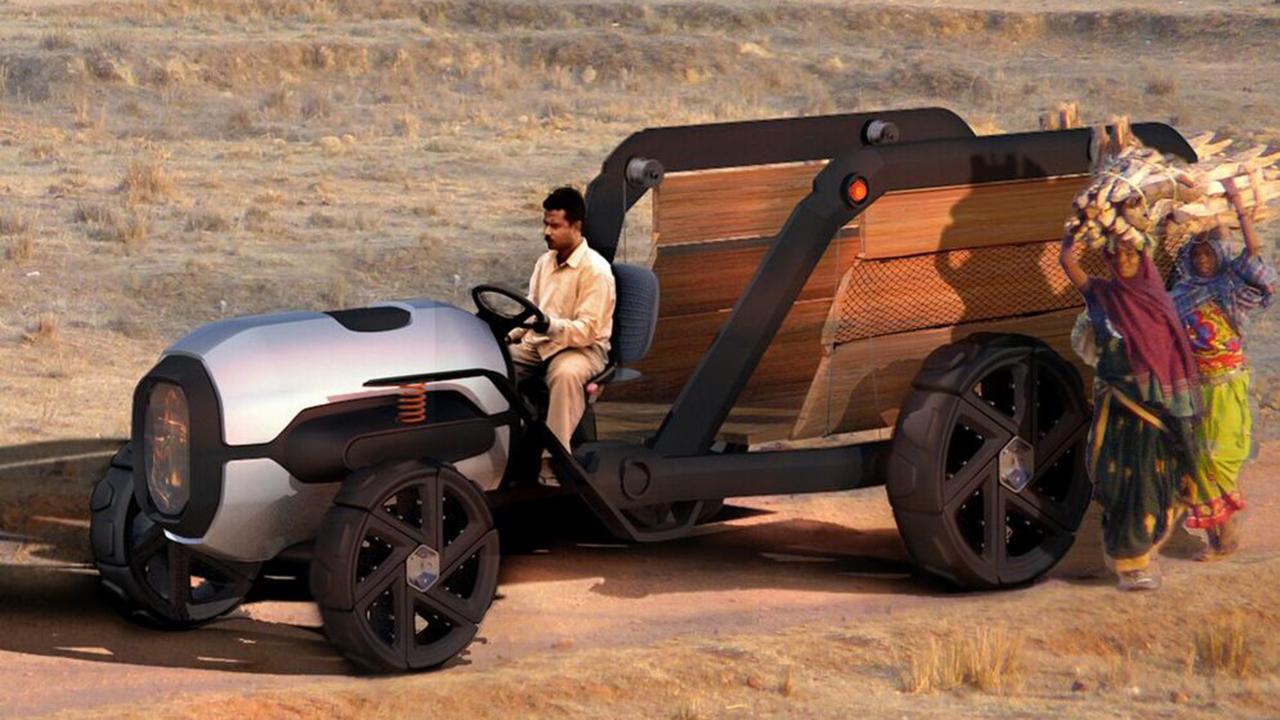
The vehicle can be driven to market - and then serve as a stall aswell (Credit: (Credit: Rajshekhar Dass and team)
“It’s a pretty small pool that car and mobility companies draw from and we believe that there are talented individuals that may not necessarily attend these schools, or be from the US, the UK and Europe.”
Michelin says its competition is open to everyone, regardless of location. The 14 wining designs were chosen from more than 875 entries, representing 68 countries.
What can we glean about a possible future for global transportation from the three top-placed entries?
First place went to a ‘community vehicle’ designed by Rajshekhar Dass, a final-year student of transportation design at DSK ISD, India. Dass and his team wanted to make a vehicle for underdeveloped  rural India, and to make modern technology more easily available. At first the vehicle looks like a traditional tractor. But look more closely, and you will see that it has detachable headlights, which can turn into street or home lighting. 
Whenever we’re looking at entries, we try not to have imaginary technologies – Ben Ebel, Michelin
The rear deck is multi-purpose – it can be used to transport crops, and then as a market stall from which to sell them. It can also be converted to carry passengers, so that a farmer can earn extra money as a taxi driver.
However it is during an emergency that the vehicle gets interesting. Because the vehicle will be connected to something like Google’s Project Loon, which uses balloons to provide internet access in remote areas, in cases of dire need it can be used as a basic ambulance.
(Credit: Edgar Andres Sarmiento Garcia)
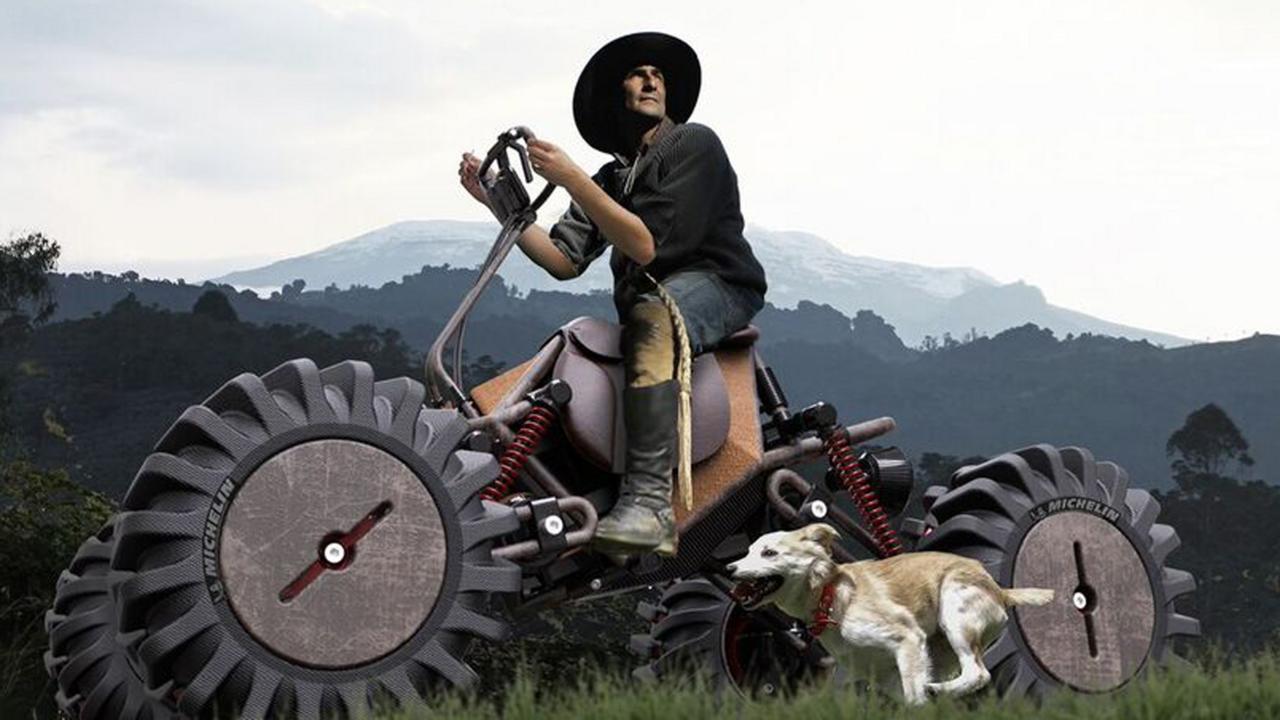
This bike is intended to traverse the same kind of terrain that mules climb (Credit: Edgar Andres Sarmiento Garcia)
“Whenever we’re looking at entries, we try not to have imaginary technologies,” says Ebel. This entry is not affiliated with Google, but the judges liked the fact that it was based around an existing initiative, and takes the idea forward. It also emphasises the idea that the concept of mobility in the future is going to involve information, as much as physical transport.
Agriculture is also the focus of the second-placed vehicle – this time in rural Argentina. There, micro production or family agriculture is king. Coffee, for example, is grown in smallholdings, and then transported by horse or mule over rough tracks to a central processing station. The Arrierio vehicle looks like a monster quad bike. It is intentionally left ‘naked’ with mechanical parts exposed. That allows it to be easily customised and maintained. This electric vehicle, by Edgar Andres Sarmiento Garcia of Bogota, Colombia is designed as a sustainable replacement for mules, capable of travelling on the same kind of rough terrain mules would use.
“This is a substitution of one device for another one,” says Ebel. “It calls into question ‘is it better, or is it just different’? This thing can be constructed and adapted to exactly what this person is going to do with it, and that shows a depth of thinking that, as a designer, I appreciate.”
You can’t just make a few more million of what you are making now – Ben Ebel
The vehicle that nabbed third place is arguably the most innovative. “Number three is a little more out there!” laughs Ebel.
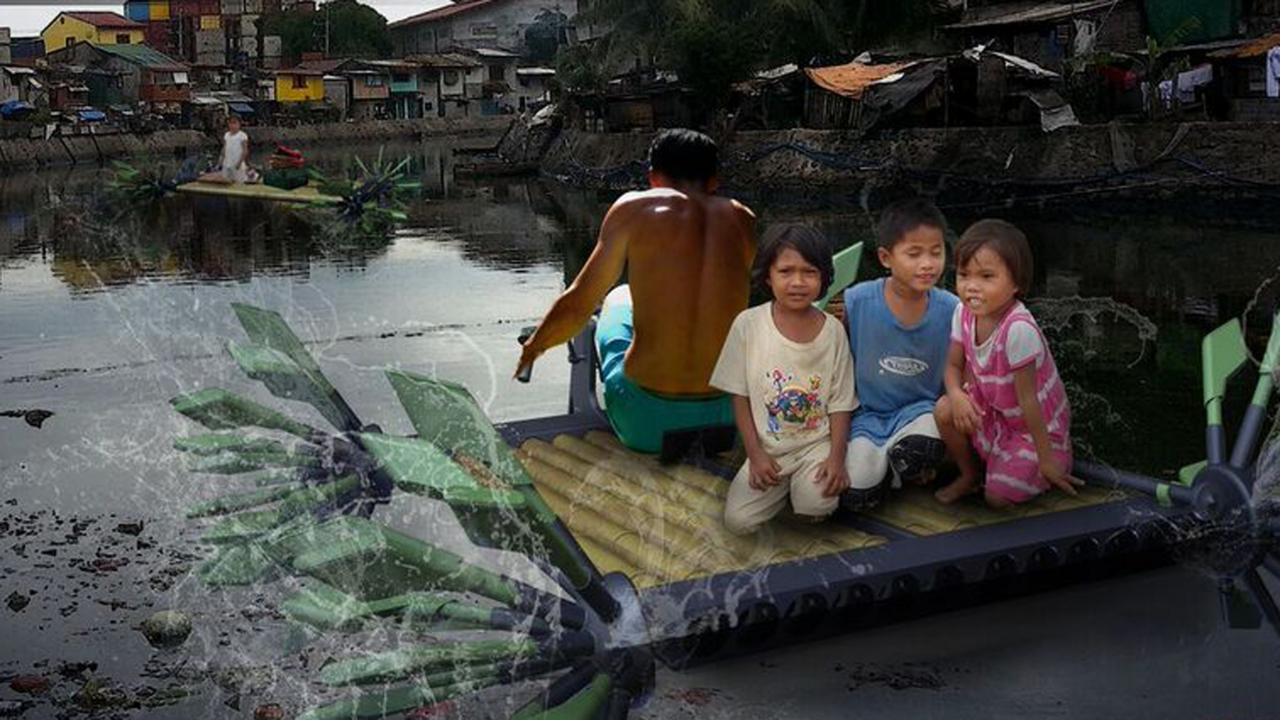
It’s called a Bamboo Recumbent, and is designed by WooSung Lee and Chan Yeop Jeong, of South Korea. Here is a concept to bring mobility to people who live in areas like Navotas, in the central Phillipines.
(Credit: WooSung Lee and Chan Yeop Jeong)
This vehicle could be used when roads become impassable because of flooding (Credit: WooSung Lee and Chan Yeop Jeong)
There, some 25 million people live in slum conditions. These are not people who are likely to buy a car, but when the area floods, they need transport. Their villages can quickly be covered in polluted water washing down from nearby waste dumps. The bamboo recumbent can be assembled from a kit of parts and some bamboo, to make a raft. As a side benefit, as parts rotate, it can even clean the water as it moves through it.
Although all of these ideas are just concepts, and you are not going to be able to buy them (well, at least not in the near future), the questions they raise may influence the design of the vehicles of the future.
“Scaling our existing auto industry is not sustainable long term,” says Ebel. “You can’t just make a few more million of what you are making now. I think for an organisation that is focused on mobility, a diversity of thinking is very important.”
Join 500,000+ Future fans by liking us on Facebook, or follow us on Twitter, Google+, LinkedIn and Instagram.
If you liked this story, sign up for the weekly bbc.com features newsletter, called “If You Only Read 6 Things This Week”. A handpicked selection of stories from BBC Future, Earth, Culture, Capital, Travel and Autos, delivered to your inbox every Friday.

วันอังคารที่ 2 กุมภาพันธ์ พ.ศ. 2559

My search for Gaddafi's golden gun


Man in blue T-shirt and baseball cap holding golden gunImage copyrightAFP
When Libyan rebels celebrated the death of Muammar Gaddafi, the colonel's gold-plated pistol was held up as a symbol of their victory - I watched as they passed it among themselves. Four years on, I've been back to Libya to find the man with the golden gun.
On my mobile phone I have a picture I took in Libya on 20 October 2011. It shows a young man in a blue shirt and a New York Yankees baseball cap. He's smiling, being carried on the shoulders of his comrades through the town of Sirte.
These men are rebel fighters from Misrata. Col Gaddafi has just been captured and killed. In the photo you can see them passing among themselves a golden pistol.
It was Gaddafi's personal handgun. In that moment it became a totem - a symbol of the rebels' victory, and of a transfer of power in a new Libya.
Nabil Ali Dagouich with gunImage copyrightAFP
Just over four years later, the country is in turmoil. Rival governments - backed by their own militias - are vying for control. Libya is fragmenting along ideological and geographical lines - east versus west, Islamist versus secularist.
The group that calls itself Islamic State is exploiting the power vacuum and has taken control of Gaddafi's hometown of Sirte.
Amid this turmoil, I've returned to Misrata. Two-hundred kilometres east of Tripoli, the city now functions as a semi-independent city state. I'm looking for the man with the golden gun. I want to know what has become of him and the other fighters who captured Gaddafi.
Gabriel Gatehouse and Anwar Suwan in 2011
Image captionGabriel Gatehouse met Anwar Suwan in 2011
My first visit is to an old contact - Anwar Suwan. He was a key figure in Misrata during the revolution. When Gaddafi was killed, fighters brought his body to Anwar, and Anwar put the corpse on public display in a large refrigerated meat locker.
Anwar's base is still much as it was during those heady days - a collection of semi-furnished shipping containers on a strip of land near the coast, overlooking the Mediterranean.
We arrive at night. It's raining and bitterly cold. There's been a power cut, so we huddle round the coals of a brazier in the dark, drinking hot, sweet tea.
"The situation is not good," says Anwar, as we look at old photographs and remember happier days.
"They cut off the head of the snake, Gaddafi. But now there are hundreds of snakes replacing him. We are still fighting for the same thing - to find a just ruler for Libya. But everyone wants to rule. There are guns everywhere. What a situation!"

Find out more

  • Gabriel Gatehouse's report The Hunt for the Golden Gun is broadcast onNewsnight on Wednesday 3 February at 22:30 GMT on BBC Two
  • A longer version will air on Our World from 20:30 GMT on Friday 5 February on BBC orld

I tell Anwar I'm looking for one specific gun: Gaddafi's golden pistol.
He mentions the name Omran Shabaan - one of the fighters who captured Gaddafi. In some of the shaky footage of that event, filmed on the mobile phones of the rebels, Shabaan can be heard trying to stop the mob from killing Gaddafi.
Another man who was there that day, Ayman Almani, shows me the footage he shot - never played in public before before. It shows the dictator's final moments more clearly than ever - he can be seen bleeding and pleading.
Media captionPreviously unseen footage of the moments just after Gaddafi's capture in 2011
"He deserved it," says Ayman, looking back on it now. "Islam teaches us not to mistreat a prisoner, not to bear a grudge. But the people got carried away in the stampede and no-one could stop them."
Omran Shabaan became a hero. He was photographed with the golden gun, and came to personify the hope that Libyans could heal their wounds after months of bitter fighting. It was not to be.
Omran Shabaan
In 2012, Shabaan himself was captured by Gaddafi loyalists in the town of Bani Walid. They beat him and tortured him. By the time the Misratans negotiated his release it was too late. He died of his injuries in a French hospital.
Anwar Suwan tells me he thinks Shabaan may have had the gun with him when he was taken. Perhaps the gun was now back in the hands of Gaddafi loyalists?
Then I show him and his comrades my picture of the man in the baseball cap.
"Mohammed Elbibi," someone recognises him. That was indeed the name I had used in the report I filed to London on that day back in 2011.
Anwar says he doesn't know what has become of Mohammed. But he promises to find out.
Gabriel Gatehouse holds the golden gun in 2011
Image captionNabil Derwish showed me the gun in 2011
Another contact, who also handled the gun, thinks the pistol is still in the city, but he doesn't know who has it.
Finally, I get hold of a phone number for Mohammed Elbibi and he agrees to meet me in his home in the centre of the city.
We sit down and I show him the picture of himself with the golden gun.
"I remember," he smiles. "I was 17 years old!"
He tells me he had nothing to do with the lynching of Gaddafi. He simply found the colonel's gun lying on the ground near the place where he was caught. But, in the confusion of the moment, and seeing him with the gun, the other rebels thought it was Mohammed who had killed him. He became the accidental hero of the revolution.
"What about the gun?" I ask him. It turns out he still has it. He shows it to me - it's a 9mm Browning handgun, gold-plated and decorated with an elaborate floral pattern.
It appears to have been a gift - Mohammed believes from one of Gaddafi's sons - on the occasion of the 32nd anniversary of the revolution that brought him to power. Almost exactly 10 years later, pictures of Mohammed Elbibi brandishing that same pistol would signal the final end to the Gaddafi era.
Gabriel Gatehouse and gun now
Image captionGabriel Gatehouse finally finds Gaddafi's golden gun again
But Mohammed is wary of his trophy. There are still Gaddafi loyalists out there, and he has received death threats.
"Please tell the world it was not me who killed Gaddafi," he says.
Did he imagine that, nearly five years later, Libya would still be at war with itself?
"I did not," he says. "I am really sad about that. When I see Libyans killing Libyans, it's too bad. Everybody wants to be like Gaddafi."

More from the Magazine

Close up of Gaddafi's gun - the words 'Made in Belgium' are visibleImage copyrightAFP
Gaddafi's golden gun bears the words "Made in Belgium" - an engraving that points to another story. Three years ago, arms experts spotted a single advanced Belgian rifle in the hands of militants in Gaza. But how had a group listed by the EU and the US as a terrorist organisation obtained the weapon? Arms expert Nic Jenzen-Jones and the BBC's Thomas Martienssen tracked its journey and traced it back to a 12m euro shipment of Belgian arms to Libya agreed in 2008.