วันพุธที่ 20 มกราคม พ.ศ. 2559

Oceans to have more plastic than fish by 2050: Report

Published by the World Economic Forum, new report says that most plastic packaging is used only once then discarded.


Only five percent of plastics are efficiently recycled [EPA]
The world's oceans may have more plastic debris than fish by the year 2050, according to a report produced by the Ellen MacArthur Foundation and published by the World Economic Forum.
Facts on plastic waste
  • Use of plastic bags has increased by 20 times in the past 50 years
  • Most plastic packaging is used only once then discarded
  • One-third of all plastic packaging escapes collection systems
  • 40 percent of plastics end up in landfills
  • Only five percent of plastics are efficiently recycled
  • Plastics production will increase to 1.124 billion tonnes by 2050

    Source: World Economic Forum
The study, released on Tuesday, found that a whopping 32 percent of all plastic packaging escapes collection systems and finds its way into natural ecosystems, including the oceans.
Currently, 8 million tonnes of plastic end up in the ocean each year - the equivalent of a dump truck of plastic rubbish every minute.
At current rates, that will have grown to two trucks a minute by 2030, and four a minute by 2050 - by which time, by weight, there will be as much plastic in the oceans as fish.
"One of the biggest problems [to] focus on is single use and disposable plastic," Dianna Cohen, CEO of the Plastic Pollution Coalition, told Al Jazeera.
Based on interviews with more than 180 experts in the field, the report found that most plastic packaging is used only once before being discarded.
"There is no system in place that helps take these [plastic] materials back [after use]," Cohen said. "It impacts the entire ecosystem in the ocean. If you come from a country that gets its primary livelihood or protein source from the ocean, then the fish you may count on to eat is ingesting plastic, getting entangled in it, and dying from having stomachs full of it."
Cohen called on governments to take steps to prevent further plastic waste by forcing producers to take back the plastic used in packaging.
"We all have the power to do something to reduce the amount of plastic we use on a daily basis," she added.

วันเสาร์ที่ 16 มกราคม พ.ศ. 2559


Endangered camel caravans of the Ethiopian salt mines

Arrival of big companies and technology advances, threaten ancient livelihood at Ethiopia's dried, salty inland seabed.


Danakil, Ethiopia - Salt miners ply an ancient and gruelling trade in Ethiopia's northeastern Danakil Depression, one of the hottest and lowest places on Earth.
Danakil contains vast salt flats as well as sulphur springs and rumbling volcanoes created by the grinding of three tectonic plates. Yet this inhospitable landscape manages to support the Afar people, a Muslim group straddling the borderlands of Ethiopia, Eritrea, and Djibouti.
Each day, Afar miners chop salt from the earth under a blistering sun, then load the minerals on to camels and donkeys which march for days to market towns to the west where the mineral is sold.
Danakil salt was once so valuable people used it as currency, but each rough hewn slab fetches only four Ethiopian birr (about 20 cents) at the mine today. With such small profits for such hard labour, the ancient trade may soon give way to more lucrative pursuits.
The Danakil also holds large deposits of potash which is used in fertilisers, and numerous mining companies are lining up to begin extraction.


A railway being built from Djibouti and a new tarmacked road traversing the old salt route may soon render the traditional camel caravan obsolete. Until then, the Afar miners will continue their tough way of life, scratching a living from this desolate stretch of salt.

วันศุกร์ที่ 15 มกราคม พ.ศ. 2559

Syrian native describes what daily life is like in ISIS' de facto capital

Business Insider
Islamic State fighters wave flags as they take part in a military parade along the streets of northern Raqqa province, Syria June 30, 2014. REUTERS/St...
(Thomson Reuters) Militant Islamist fighters wave flags as they take part in a military parade along the streets of Syria's northern Raqqa province.
A Syrian native wrote two columns this week describing what day-to-day life has become in Raqqa, Syria — the de facto capital of the terrorist group ISIS.
He wrote of a city where a person's appearance could get him or her arrested if it's not in line with ISIS rules, where people are forced to attend indoctrination classes at mosques, and where residents have become so desensitized to airstrikes that they no longer bat an eye at them.
Many Syrians vowed to stay after the start of the country's civil war in 2011. For the past five years, rebels have been fighting the regime of Syrian President Bashar al-Assad, who has been known to commit atrocities against civilians as he tries to hang onto power. Jihadist groups have also moved into Syria to take advantage of the power vacuum that has opened up amid the chaos.
"For me, Raqqa was my hometown and leaving was out of the question," Marwan Hisham (who uses a pseudonym) wrote for The New York Times. "Even under bombardment, people managed to keep their businesses running. I worked two jobs."
But with ISIS (also known as the Islamic State, ISIL, or Daesh) moving in, it's become more difficult to continue with any semblance of normalcy.
"The Islamic State's capture of Raqqa in January 2014 sparked a demographic change in the city unlike any it had seen before," Hisham wrote in a separate Foreign Policy column. "Foreign fighters flocked to the city, bringing their families with them."
Those belonging to groups that aren't part of ISIS' privileged class (Sunni Muslims) were encouraged to leave the city.
"In the ugliest form of colonization, the group's members moved about, looking for houses to lodge in," Hisham wrote. "They started with Syrian regime officers' houses, homes formerly belonging to Syrian rebels, or government housing projects."
Ethnic Kurds were also largely driven from Raqqa.
"Kurds used to live side by side with their Arab neighbors in Raqqa," Hisham wrote. "But now, as the fighting between the Islamic State and the Kurdish militia known as the People's Protection Units (YPG) intensifies, they have been forced out of their homes."

View gallery
.
Raqqa Syria
(REUTERS/Nour Fourat) Residents rest by the Euphrates River in Raqqa, eastern Syria, April 11, 2014.
Those who agree to join ISIS can request permission from ISIS leaders to take over the abandoned homes of their former neighbors, Hisham explained.
"The Islamic State has fixed its attention on government employees' apartments," Hisham wrote. "Once it is known that an employee has moved out, the jihadis will break into the apartment and claim everything inside it. If the owner doesn't show up in person to reclaim his possessions — and who would? — all belongings are transferred to the new occupant selected by the Islamic State."
ISIS justifies these takeovers by saying that the confiscated apartments are now state-owned. Therefore, ISIS (which considers itself a legitimate state) can decide how to distribute them.
Jobs are hard to come by in Raqqa, especially for those who don't want to work for ISIS. Most government operations have shut down, and many educated people have turned to subsistence farming to feed their families, Hisham wrote in The Times.
One friend of Hisham's, Abdulrahman, is an engineer who used to work for Syria's Department of Finance before ISIS moved in. He had an apartment and a nice car, but now he "makes a meager living growing vegetables," Hisham wrote.
Because of these dire circumstances and lack of work opportunities, some turn to ISIS even if they don't agree with the group's radical ideology.
"I've seen first hand that for Raqqa's teenagers, the Islamic State's ideology has zero appeal," Hisham wrote. "What they want is its money and its guns."

View gallery
.
SyriaMapJanuary2015
(Reuters) And ISIS pays more than most people would be able to make otherwise. A fighter could start out earning $200 a month in Raqqa, which is more than a family needs to survive, Hisham wrote. Fighters are paid more for each wife, child, and slave he brings to the table, plus extra money for provisions. And this is all separate from the housing ISIS provides — once a fighter applies for a house, he'll typically get it in about two months.
Aside from the financial incentives, the respect and fear that comes with being an ISIS fighter appeals to some young men.
"These young men want to be listened to when they speak, and feared," Hisham wrote. "These motives — 'respect, cash and guns' — are turning ordinary young people into murderers."
There are work opportunities outside of becoming an ISIS fighter, as well. One of Hisham's acquaintances, for example, works as an accountant for ISIS' drinking-water department and earns $100 per month.
Fighters are highly valued, however. And they're dying off so quickly in battle that ISIS has now reportedly resulted to drafting people into its terror army.
"Near the front line where the Islamic State is fighting the Kurdish People's Protection Units, or YPG, the jihadists have already conscripted one man from every family," Hisham wrote. "They claim it's so they can 'defend their villages.'"
Raqqa residents have feared this happening for quite some time — Abu Ibrahim al-Raqqawi, an activist with the group Raqqa is Being Slaughtered Silently, told Business Insider in October that ISIS authorities in Raqqa started forcing males over the age of 14 to register with their militant-run government.
"There are rumors in the city that, 'Boys must not sit at home like women,'" Raqqawi said. "There is a war. They need to go to jihad.'"

View gallery
.
Raqqa, Syria
(REUTERS/Nour Fourat) Islamic State billboards are seen along a street in Raqqa, eastern Syria, which is controlled by the Islamic State, October 29, 2014. The billboard, right, reads: "We will win despite the global coalition."
ISIS is reportedly preparing to defend its hold on Raqqa from an upcoming assault led by the YPG and other anti-ISIS, anti-Assad rebels.
As a US-led coalition and local rebels prepare for a fight to take Raqqa back from ISIS, airstrikes have become a nightly routine in the city, Hisham wrote.
"When the jet fighters interrupt, all eyes turn to the sky," Hisham wrote in Foreign Policy. "Everything here is a target, because the Islamic State is everywhere. But once the bombs are dropped, people go back to what they were doing. It's no longer a moment of reflection about life and death, nor a moment of curiosity about what happened: It's something that has no ending."
Hisham described how locals are victimized by both western airstrikes and by ISIS itself. The group has implemented strict rules in its "caliphate," the territory it controls in Iraq and Syria, and breaking them could mean public whippings, being forced to attend indoctrination courses on ISIS' version of Sharia law, or worse.
"The Islamic State used any excuse to preach their ideology to Raqqa residents," Hisham wrote. "You could be a poor person who asked for zakat, the money taken from the rich as alms, without first registering with the Islamic State, or a government employee who studied in the Assad regime's schools and therefore have a 'non-Islamic education,' or a graduate of a 'secular law' school — all are forced to submit to indoctrination."
Other offenses include not dressing according to ISIS rules (veils for women and long beards for men).
Some lawbreakers are forced to dig trenches around the city, which exposes them to airstrikes.
Hisham concluded his Times column by offering advice on what could put an end to ISIS' reign of terror in the Middle East and across the world.
"The people under this occupation present the best hope for destroying the jihadists," he wrote. "Without their support, the Islamic State can hardly be defeated."

วันพุธที่ 13 มกราคม พ.ศ. 2559

Top 10 Travel Experiences in Cuba


Picture of old classic cars and taxis on street in downtown city of Havana, Cuba
Classic 1950s cars and taxis line the street in downtown Havana.
Photograph by Bill Bachmann/Alamy Stock Photo
  1. Saunter the Colonial Plazas of Old Havana

    Founded in 1519 and declared a UNESCO World Heritage site in 1982, beguiling and beautiful Habana Vieja (Old Havana) is today a remarkable 350-acre trove of cobbled plazas and colonial buildings fringed with colonnaded arcades. The boot steps of conquistadors still echo down narrow streets, transporting you back through the centuries. Plan at least two days to explore fully. Start at airy, tree-shaded Plaza de Armas, site of the city’s founding. Delve inside the Castillo de la Real Fuerza—the oldest fort in the Americas—to admire its superb museum of maritime history; and the Palacio de los Capitanes Generales, the glorious former Spanish governors’ palace, now the Museo de la Ciudad teeming with historical artifacts. Now stroll to Plaza de la Catedral to admire its exquisite baroque cathedral: “Music turned to stone,” thought Cuban novelist Alejo Carpentier. Next, follow Calle Mercaderes south to magnificently restored Plaza Vieja, replete with sites of interest: Don’t miss the Museo de Naipes (Museum of Cards). Cuba, inhabited by 91,000 people, is far from an abandoned stage set and more like a living museum. To savor its earthy, timeworn appeal, saunter southern Habana Vieja, a vibrant ecclesiastical zone where centuries-old grime is soldered by tropical heat into dilapidated façades.
  2. Delve Into the Tobacco Fields of Viñales, Pinar del Río

    The Valle de Viñales, a three-hour drive west of Havana, is renowned for its sensational landscapes. Arriving is a jaw-dropper as you suddenly emerge into the broad vale framed by soaring mogotes—sheer-sided, conical limestone hills underlain by subterranean caves. The valley is quilted with tobacco fields, or vegas, and studded with tent-shaped thatched huts, where fresh-cut leaves are cured on poles until brown, like smoked kippers. Ox-drawn ploughs add a sense of time standing still as they till the rust-red soils into furrows. At its heart, Viñales village resounds to the clip-clop of hooves and the crowing of roosters. A highlight is a boat journey amid dripstone formations and the gloom of the Cueva del Indio. Adventurers can hike or take a horseback ride to the top of the mogotes, spelunk the labyrinthine Cuevas de Santo Tomás, or even scale the mogotes with a guide. Don’t leave before heading to the Hotel Los Jazmines, atop the valley’s southern rim, for spectacular sunset or sunrise views.
  3. Ride in a Classic 1950s American Automobile, Havana

    The visitor’s first reaction to Havana is of being caught in a 1950s time warp. Yank tanks from the heyday of Detroit are everywhere. American cars flooded Cuba for 50 years culminating in the Fulgencio Batista era, when no other country in the world imported so many Chryslers and Chevys and Cadillacs. Then Fidel Castro and company made a revolution and spun off into Soviet orbit, invoking a U.S. trade embargo that in terms of American automobiles has cast a time-warp spell over Cuba. “Was this a movie set or a real city?” wrote Tom Miller in Trading With the Enemy. “Cars missing from American highways for decades lined every block.” Don’t just ogle. Hop in a colectivo (a shared taxi that runs along fixed routes) to ride with Cubans squeezed like sardines in a tin as the radio blasts out a rumba. Now treat yourself by hiring a convertible—perhaps a 1958 Edsel or Cadillac Eldorado with fins sharp enough to draw blood—for a sightseeing ride around town.

    Travel Tip: You can hire private classic-car taxis outside the deluxe hotels, where the best convertibles are to be found.
  4. Hike to Castro’s Rebel Army Headquarters in the Sierra Maestra, Granma

    Cuba’s highest mountains culminate atop Pico Turquino (6,476 feet). Incised with precipitous ravines and sparsely inhabited, this forbidding and thickly forested terrain was the setting for Fidel Castro’s ridgetop headquarters during the nearly three-year armed struggle (1956-58) to oust dictator Fulgencio Batista. The site—La Comandancia de la Plata—is reached by a two-hour hike along a narrow trail. Now a museum, the restored rebel army HQ includes Castro’s office and sleeping quarters and a basic infirmary that was run by Che Guevara. A guide is compulsory. Arrangements can be made with EcoTur in the hamlet of Santo Domingo, where a rustic riverside hotel squats in a tight-hemmed valley. A 4WD taxi will haul you up the near vertical switchback ascent to the trailhead at Belvedere Alto de Naranja.
    Fun Fact: Castro’s hut had no discernible doorway and featured an escape hatch into the stream below.
  5. Thrill to the Tropicana Cabaret, Havana

    “Señoras y señores … showtime!” The lights go down. The house band belts out a rumba. And floodlights flick on to sweep over feathered, scantily clad showgirls, or figurantes, parading among the palm trees like tropical birds. Welcome to the Tropicana, Cuba’s open-air extravaganza now in its eighth decade of Vegas-style, stiletto-heeled paganism. Acrobats and crooners are also featured in this flamboyant cabaret espectáculo (show), highlighted by the figurantes’ sashaying kaleidoscopically in minimalist yet sensational costumes. Nat King Cole, Josephine Baker, and Carmen Miranda once headlined "Paradise Under the Stars," which opened on New Year’s Eve 1939 in an open-air theater in the district of Marianao, with palms and other tropical trees as part of its setting. The venue is still the original. Every Cuban town has at least one espectáculo, although the Tropicana is a tourist-only affair due to its exorbitant cost. The Tropicana is considered a national institution—the pinnacle of a performance art as quintessentially Cuban as cigars and rum. “Cabarets are part of Cuban tradition. They’re integral to Cuban culture,” says Sandra Levinson, executive director of the Center for Cuban Studies in New York.
    Travel Tip: Male patrons are given a cheap machine-rolled cigar. If you plan on smoking, bring your own hand-rolled cigar.
  6. Visit Fidel Castro’s Birthplace at Birán, Holguín

    Finca Manacas, the country estate where Fidel Castro was born in 1926, is now open to the public as Museo Conjunto Histórico Birán. This off-the-beaten-track venue provides a fascinating insight into Castro’s formative years, although the guided tour and exhibits paint an idealized portrait of Castro’s early life. You’ll be shown Castro’s crib; portraits of his father, Ángel Castro y Argiz, a wealthy patriarch who owned almost every business for miles around; and portraits of his mother, Lina Ruz González, the family housemaid who Castro’s father married in 1943 after divorcing his wife. Yes, Castro and his brother Raúl were born out of wedlock. The parents are buried in a simple grave next to the schoolhouse, where Castro’s desk—surprise!—is front row center. Eleven of the estate’s original 27 structures still stand, although the family home was rebuilt after a fire. It displays Castro’s childhood hunting rifle, his baseball mitt and uniform, and other original memorabilia.
  7. Explore the Cobbled Streets of Trinidad, Sancti Spíritus

    Founded as one of Cuba’s original seven cities in 1514 by conquistador Diego Velázquez, Trinidad is Cuba’s crown jewel of colonial cities. Three centuries ago it rose to wealth as a center for sugarcane production and the slave trade. Declared a UNESCO World Heritage site in 1988, its historic, traffic-free core has been restored. It’s sheer joy to serendipitously wander the sloping cobbled streets lined with exquisite 18th- and 19th-century buildings—each painted in ice-cream pastels—that evoke the wealth of a bygone era, when the nearby Valle de los Ingenios (Valley of the Sugar Mills) boasted at least 50 mills. The town thrives on tourism. Art galleries, crafts shops, plus private restaurants and casas particulares (private homestays) abound. Yet the mood and yesteryear pace are unsullied. Tucked on a hillside between the Sierra Maestra and the turquoise Caribbean Sea, it offers fine views and easy access to both.
  8. Go Birding in Parque Nacional Ciénaga de Zapata, Matanzas

    Crocodiles, manatees, garfish, and at least 258 of Cuba’s 374 bird species inhabit the Zapata Swamps. Protected within the UNESCO Reserva de la Biosfera Ciénaga de Zapata, the 1,893-square-mile Zapata Swamp National Park unrolls across a vast triangular peninsula of freshwater and brackish lagoons, coastal mangroves, and reedy swamps studded with woodsy thickets. Resembling the Everglades of Florida, the swamps form the largest wetland ecosystem in the Caribbean as well as Cuba’s premiere birding venue. Zapata boasts 21 of the island’s 25 endemic bird species. Three species are found only here: the Zapata sparrow, Zapata wren, and critically endangered Zapata rail, sighted in 2014 for the first time in 40 years. Garrulous Cuban parrots fly overhead, squawking all the while: The population is recovering from near extinction thanks to a local breeding program and educational efforts to stop the local pet trade. The beyond gorgeous tocororó, or Cuban trogon, is easily spotted. Bring binoculars, though, to spy the zunzuncito—the bee hummingbird (Cubans call it pájaro mosca, or fly bird). It’s the world’s smallest bird. Roseate spoonbills and neon-pink flamingos strut around Laguna de las Salinas on Zapata’s southern shores. Migratory waterfowl flock in October through April. Hire experienced guides (compulsory) at the park headquarters at Playa Larga, site of the Bay of Pigs invasion in April 1961.
  9. Eat Authentic Cuban Food in Baracoa, Guantánamo

    Local Cuban fare—comida criolla—is country food, relying on lowly staples, and varies little throughout the country. Roast chicken and pork are the ubiquitous base for most meals, usually accompanied by rice and black beans (sometimes cooked together as congrí), plantains (plátanos), and starchy root vegetables (viandas) such as sweet potato (boniato) and cassava (yucca). Cuba’s extreme northeast, around Baracoa, is the only region that can claim a distinct cuisine. Coconut milk is the main ingredient, infusing divine flavors when cooked with spinach-like calalú or with crab and grated plantain simmered inside a banana leaf to make batán. Shredded coconut meat mixed with papaya, orange, and sugar combine to make an ambrosial dessert called cucurucho. Cacao is another local staple, providing the main ingredient for chocolate and various drinks. Tiny endemic fishes called tetí are used in dishes that trace a lineage back to the indigenous Taino people. Delicious!
    Travel Tip: To savor local fare, dine at El Poeta, a paladar (private restaurant) whose owner, Pablo Leyva, sings impromptu verse.
  10. Be Awed by the Parrandas de Remedios, Santa Clara

    It could well be the world’s wildest fireworks extravaganza, a tropical yuletide bacchanal that will replay in your mind forever. Some 14 communities of the Villa Clara province hold Mardi Gras-style festivals called parrandas at various times of the year. But the singularly beautiful colonial city of Remedios claims the largest, the most famous, and by far the most flamboyant. If you’re visiting Cuba during Christmas, this is the place to be. Dating back to the 19th century, parrandas are friendly battles in which the townsfolk divide into two historic camps and compete to see who can produce the most impressive parade float (carrozas) and giant neon-lit static displays (trabajos de plaza) and, of course, the most insane fireworks demonstrations. Each camp is represented by a mascot. The Sansacrices (from Remedios’s San Salvador district) are represented by a rooster; their rivals, the Carmelitas (from El Carmen), are represented by a hawk. There are no judges or juries. Common consent decides who wins.
    Travel Tip: Don’t wear flammable clothing, and don a wide-brimmed hat. Be warned: Errant homemade rockets whiz through the streets, and giant homespun Catherine wheels the size of tractor tires often spin out of control.

วันอาทิตย์ที่ 10 มกราคม พ.ศ. 2559

Where to See the Smallest Penguins on Earth


The Penguin Parade—where thousands of little penguins emerge from the ocean like clockwork at sunset to return to their burrows on Phillip Island, a mere 80-mile drive from Melbourne—is one of Australia’s star tourist attractions.
Given the popularity of the nightly march, I was worried about a theme-park vibe. But when I saw the first group of penguins come waddling out of the ocean, determined and adorable, I drew a giddy breath. It was just plain awesome.
Fairy penguins on Phillip Island (Photograph by marcusfrieze, flickr)
When I was there in November, a strange phenomenon had occurred. The penguins, which are only found in southern Australia and New Zealand, typically breed once a year, in October, but, due to unseasonably warm waters, the island had seen its first chicks in late August and was preparing for a second brood.
“This is very unusual,” Roland Pick at Phillip Island Nature Parks, the organization that oversees the parade, told me. “[The penguins are] incredibly sensitive to changes in sea surface temperatures.”
After learning about some of their other characteristics, I couldn’t help but anthropomorphize the diminutive seabirds. “They may pair up for life, or just a season or two,” Roland said. “If the males aren’t good breeders, the [females] kick them out. We even call it the divorce rate when they split up.”
Some may grumble that the parade puts the penguins on unnecessary display, especially because the animals are so sensitive. But, as Roland explained: “If we didn’t have the visitors center [where the nightly procession takes place], the colony wouldn’t be here now.”
Little penguins have bred for thousands of years along the Phillip Island coastline, but when the rural island was connected to mainland Victoria by a bridge in 1939, the interest in the penguins—and in owning beachside property on the island—skyrocketed.
Eventually, in 1985, the Victorian government decided to halt all new development and begin buying back private homes at Summerland Beach in order to save the penguin rookery that we see there today.
Phillip Island may be best known for these little creatures, but there is plenty to do during the day before the sunset march.
Save time to hop the bridge for lunch at the Churchill Island Heritage Farm. Work up your appetite by participating in daily agricultural activities like sheep shearing and cow milking, then hit the stand-out on-site cafe for a bite with a bucolic view.
The island also boasts a brand-new interactive exhibit located on its western extremity called “Antarctic Journey” that had me as ecstatic as an 8-year-old.
When you look out toward the Nobbies, a stunning rock formation that is home to Australia’s largest brown fur seal colony, it’s incredible to think that the next stop is basically Antarctica.
The exhibit uses advanced virtual reality to make visitors feel as if they’re in the middle of Earth’s southernmost continent. You can see yourself on an ice platform with penguins and whales and even “feel the freeze” in a chilled room.
The Koala Conservation Centre, where you can roam on the boardwalks to get an up-close look at the eucalyptus-munching marsupials in the wild, is also worth a quick visit.
Tourist can get up close to the wildlife at the Koala Conservation Centre (Photograph by shinythings, flickr)
Tourists can get close to wildlife at the Koala Conservation Centre (Photograph by shinythings, flickr)
Before the penguin procession gets underway, I’d recommend dinner at Youki’s, a Japanese tapas restaurant. The cafeteria-style seating and bright lights don’t compete with the incredibly fresh sushi and teriyaki bowls on offer.
After the main event, as the light faded to total darkness, I was happy to return to Glen Isla House, a heritage bed-and-breakfast with beautiful gardens and a short path to the beach run by Ian and Madeleine Baker, who both exude a twinkly-eyed hospitality.
“Marrying Madeleine was the best decision of my life,” Ian told me. They’ve been together for 44 years.
After spending years traveling the world and gathering inspiration from the properties where they had stayed, the couple decided Phillip Island was in need of a delightful small hotel and hatched a plan.
Ian, a former business exec, enrolled in cooking school for three years and ended up apprenticing under his son, Martin, an accomplished chef himself.
His training brings an unexpected level of culinary sophistication to the small B&B—a fact I experienced in the morning with one of the best meals of my entire trip through Victoria. Ian prepared poached eggs and grilled bacon sourced from the nearby Mornington Peninsula, while Madeleine contributed a huge dollop of creamy yogurt from Gippsland Dairy laced with sweet and puckery local rhubarb.
Once the penguin parade concludes, most visitors climb onto tour buses headed for a midnight arrival in Melbourne. But if you come to Phillip Island, think seriously about making it an overnighter. In my case, the stay was as memorable as the island’s famous little denizens.
Tip: There are three different ticketing tiers for the Penguin Parade, including the general viewing deck. But I recommend the new Penguins Plus platform, which gets you even closer to the action.
Annie Fitzsimmons is Nat Geo Travel’s Urban Insider, exploring the cities of the world with style. Follow her adventures in Victoria, Australia, on Twitter @anniefitz and on Instagram @anniefitzsimmons.

วันศุกร์ที่ 8 มกราคม พ.ศ. 2559

Jonathan the giant tortoise gets new lease of life aged 183

The world's oldest living animal has been given a new lease of life after a vet put him on a healthy diet - at the age of 183.

Jonathan the giant tortoise

Jonathan the giant tortoise is the world's oldest living animal
It was feared Jonathan the giant tortoise was on his last legs after his health seriously declined due to losing his eyesight and sense of smell.
The afflictions meant Jonathan, who lives on the British outpost of St Helena Island, was left grabbing at insubstantial twigs, leaves and dirt for food.
His plight was spotted by the island's vet, Dr Joe Hollins, who immediately put him on a high-calorie and nutritious diet of a bowl of apples, carrots, cucumber, bananas and guava.
Since the change Jonathan has started coming back out of his shell again. He has gained weight, redeveloped his sharp-edged beak to help him eat grass and become more active.
The famous reptile can be seen happily plodding the grounds of Plantation House, the home of the governor of St Helena where he has lived since coming to the island in 1882.
Jonathan was approximately 50 years old when he arrived on the small island in the south Atlantic from the Seychelles in the 19th century.
Following the death of Harriet, a 175-year-old giant Galapagos Land tortoise, in 2005 in Australia, Jonathan has been recognised as the world's oldest living land animal.
And with his new diet experts say there is no reason why he can't go on to reach his double hundred and more.
Despite his improvement in health Jonathan is too old to be used for a breeding programme to help boost the numbers of the vulnerable Seychelles giant tortoise.
It is thought the stress of transporting him to the archipelago in the Indian Ocean would be too much for him let alone the rise in blood pressure from a lustful liaison with a female.
Jonathan

Jonathan started coming back out of his shell again after he started the nutritious diet
Jonathan
 
Eight British monarchs from George IV to Elizabeth II have been crowned during his lifetime
He has put on weight and is a lot more active
Dr Hollins
Dr Hollins said: "Jonathan has become almost completely blind due to cataracts and has lost his sense of smell. He was just grabbing at food and ended up chomping on twigs which blunted his beak.
"He lost weight because of his nutritional deficiencies. I changed his diet and started to give him a mixed bowl of fruit and vegetables like apples, carrots, lettuce, guavas and bananas which are very high in calories.
"Since then his life has been transformed. He has put on weight and is a lot more active and is walking more than he used to.
"He has more fat cover which will help him in the winter and has good nail growth.
"The life expectancy of a giant tortoise is 150 but there is no reason why Jonathan won't still be here after we have all gone."
Jonathan was a gift to the governor of St Helena from the Seychelles in the late 19th century but he wasn't given the name until the 1930s by governor Sir Spencer Davis.
Jonathan currently shares his enclosure
 
Jonathan currently shares his enclosure with four other giant tortoises
In his time on St Helena he has seen 28 British governors come and go.
Eight British monarchs from George IV to Elizabeth II have been crowned during his lifetime and 51 British Prime Ministers have served at 10 Downing Street.
He currently shares his enclosure with four other giant tortoises; David, Emma, Frederika and Myrtle.
Dr Hollins, 58, said in his five years on St Helena he has never seen Jonathan get amorous with the three females, preferring to leave that to David who is many years his junior.
St Helena, in the south Atlantic, was chosen as the place of Emperor Napoleon's second exile and the French dictator died there in 1821.

The way of the one-legged rowers

  • By Adrienne Jordan
8 January 2016
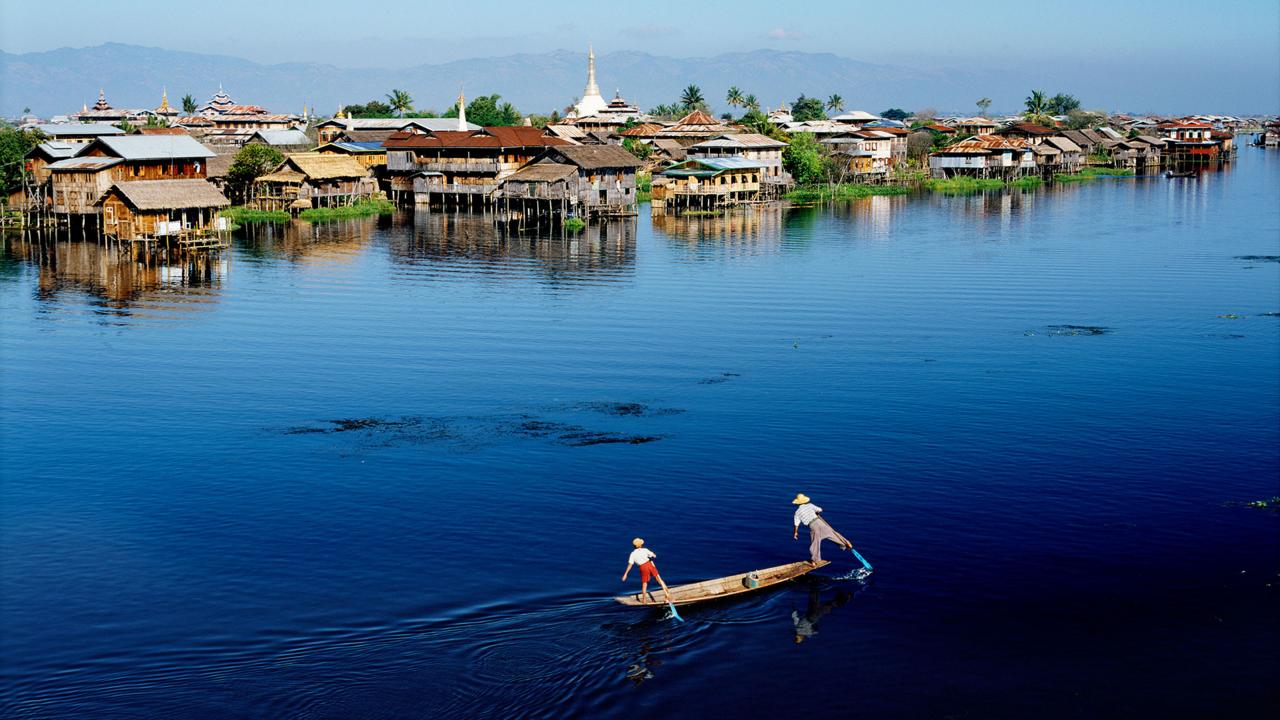
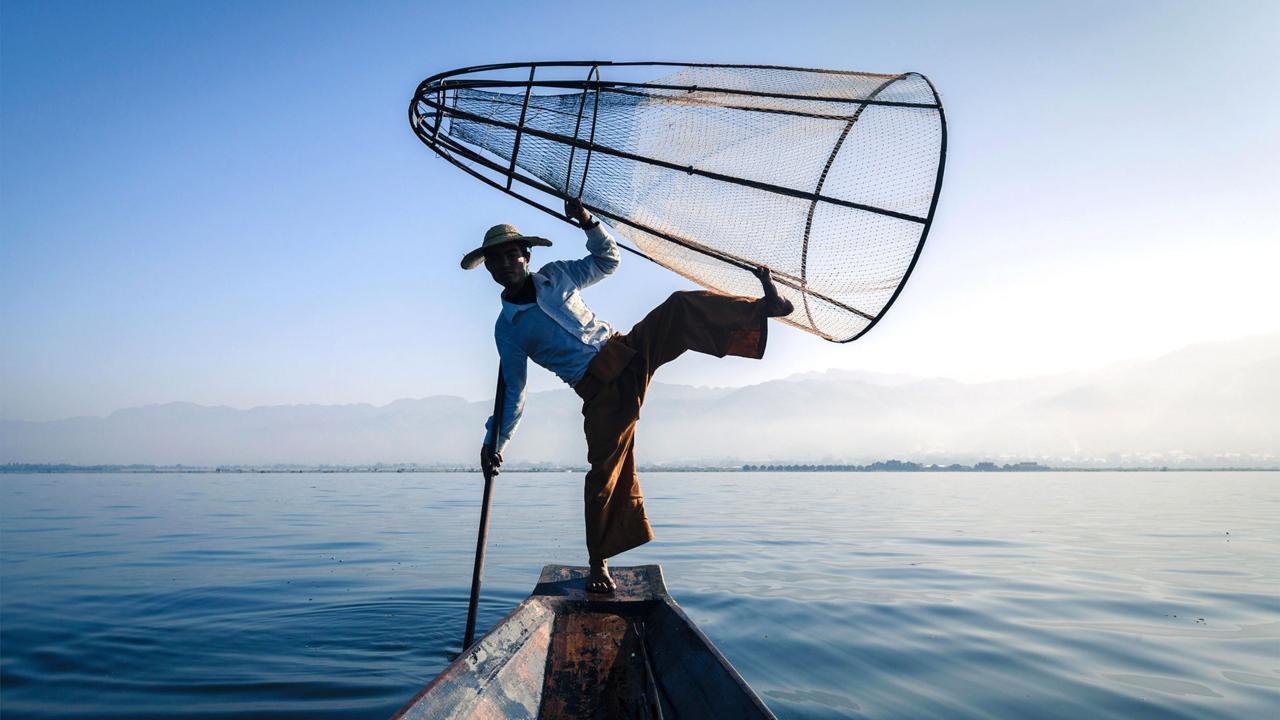
I was in a sky blue motorboat traversing Myanmar’s peaceful Inle Lake – the second largest in the country. Surrounded by mountains and clusters of colourful floating homes, I became mesmerised as the water swayed to the beat of the of the Intha fisherman, who expertly manoeuvred their tiny wooden boats by rowing with one leg.

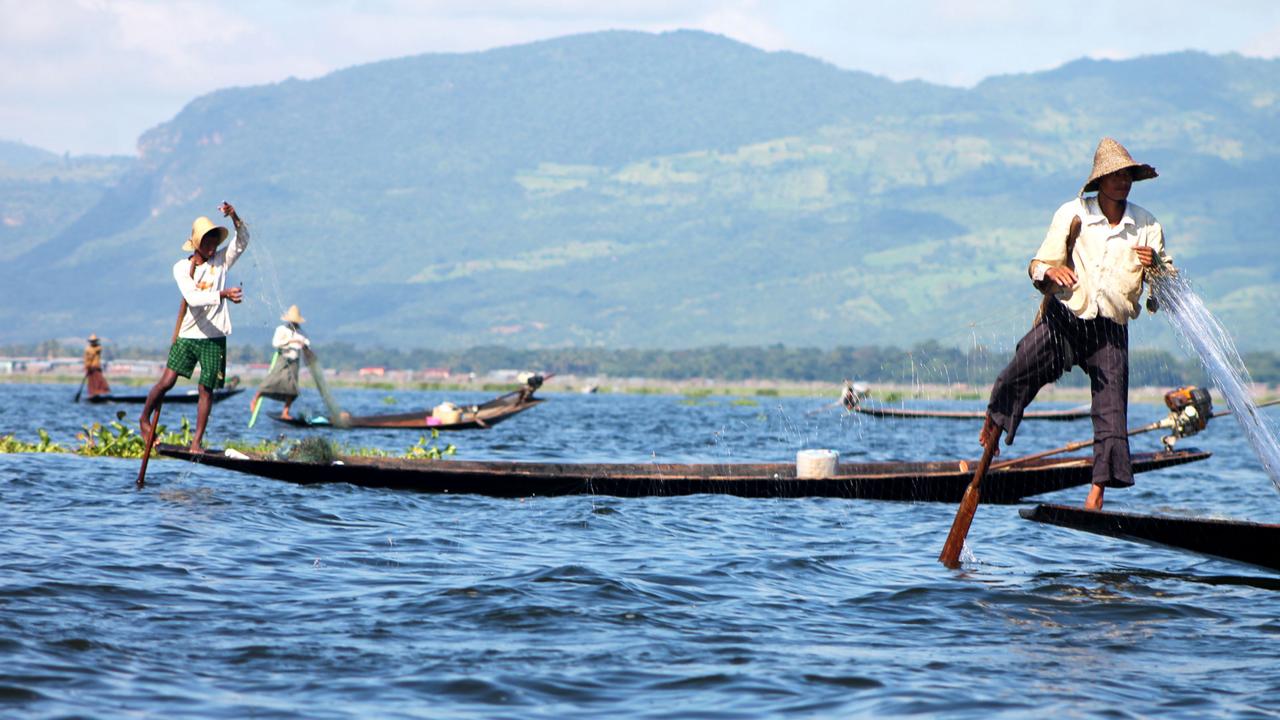
With meditative expressions, a group of three fishermen deftly rowed by while standing upright. Each had one leg wrapped around a single oar, leaving their sunburned hands free to manipulate the conical fishing nets they cast over the glistening water. This skill, unique to Inle Lake, takes a high level of balance, agility and strength. The fisherman have to determine the right amount of pressure to put on their free leg, while their other leg steers, turns and uses the oar to slow the boat down.

The rowers appear to have wooden legs from certain angles (Credit: Credit: Adrienne Jordan)
The rowers appear to have wooden legs from certain angles (Credit: Adrienne Jordan)
 “I tried many times to practice that distinctive rowing style but I always fell down into water.”
“One might think it is easy. I did!” laughed Nyein Moe, my local guide during a trip with Trafalgar tours. “I tried many times to practice that distinctive rowing style but I always fell down into water.”

As we passed through the floating community, the fishermen used the small boats to transport themselves around. They went to the floating markets and to pay their neighbours a visit by rowing from house to house. Not one had fallen into the water.

The fishermen travel in small canoe-like motorless boats (Credit: Credit: Blend Images/Alamy)
The fishermen travel in small canoe-like motorless boats (Credit: Blend Images/Alamy)
Around 200,000 people comprise Inle Lake’s Nyaung Shwe township, which includes various Myanmar ethnicities. However, the Intha or “lake people” make up the majority of the population. “The ‘In’ stands for lake and ‘tha’ means people in Burmese,” said Moe. The Intha community is self-sufficient when it comes to cultivating food and building materials.
“Their lives are dependent on this water.”
“Their lives are dependent on this water,” Moe explained, adding that they live on shore or in floating homes and flourish by fishing and cultivating arable rice paddies on the river’s delta. They also build floating gardens to grow produce, piling weeds and compost on long poles fixed to the lake floor.

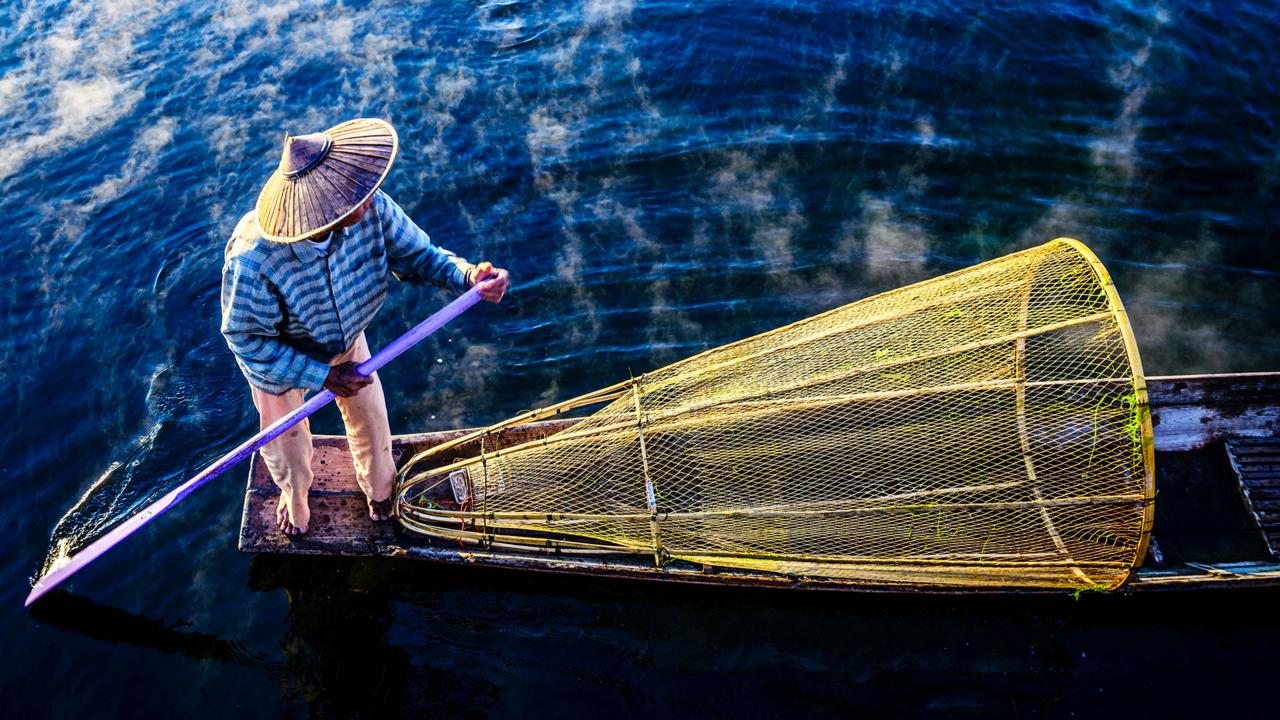
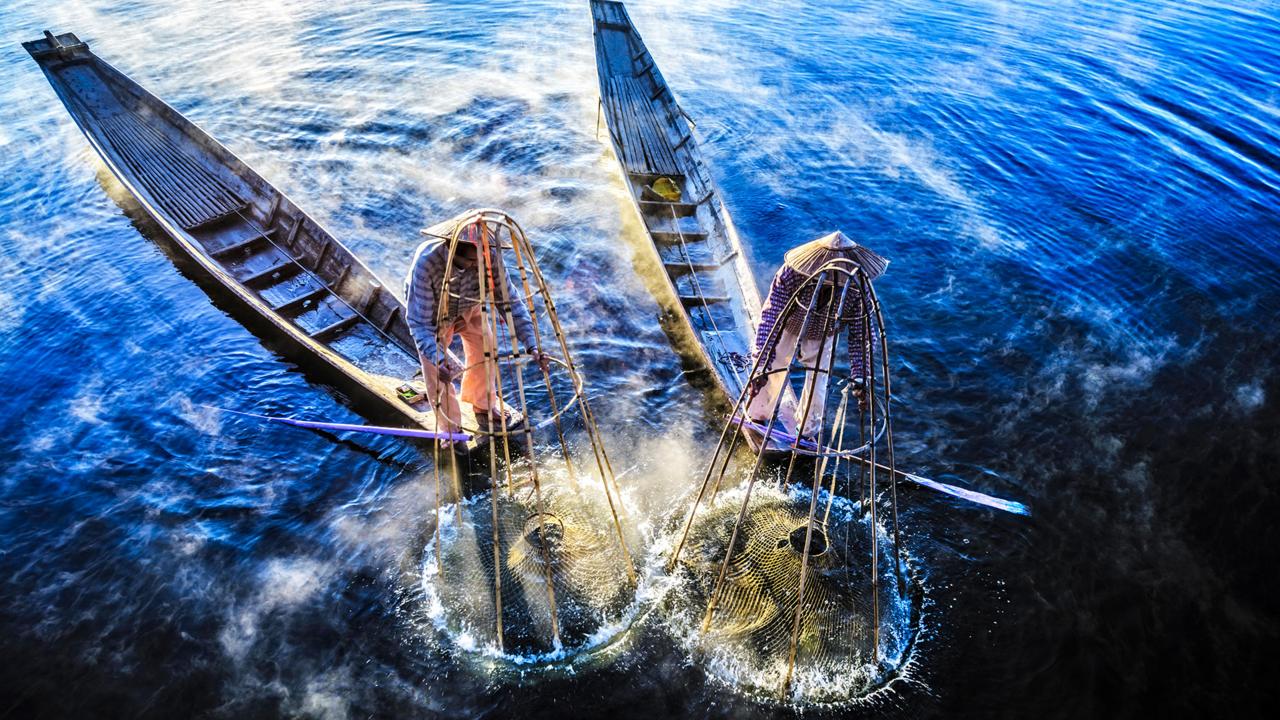
The fishermen snag their prey in massive baskets (Credit: Credit: Blend Images/Alamy)
The fishermen snag their prey in massive baskets (Credit: Blend Images/Alamy)
While believed to date back to the 12th Century, the exact origins of this one-legged rowing practice are still a mystery. However, as I witnessed this spectacular skill in person, I realized that it has likely survived for hundreds of generations because of its distinct advantages. The upright position allowed fisherman to see across the lake and spot dense hyacinth weeds just below the surface, where fish could be hiding. The fishermen were also able to keep close watch on bursts of bubbles created by shoals of fish. Ingenious, indeed.
The one-legged rowers exhibit masterful balance on the water (Credit: Credit: Dmitry Rukhlenko/Alamy)
The one-legged rowers exhibit masterful balance on the water (Credit: Dmitry Rukhlenko/Alamy)

BBC's Travel Show sent Rajan Datar to get a first-hand look at the one-legged rowers and the floating gardens of Inle Lake. The Travel Show brings you the latest insider travel news, a wealth of destinations, amazing experiences and features and practical hints, tips and advice for your holidays.
....................................................................................................