วันอาทิตย์ที่ 10 มกราคม พ.ศ. 2559

Where to See the Smallest Penguins on Earth


The Penguin Parade—where thousands of little penguins emerge from the ocean like clockwork at sunset to return to their burrows on Phillip Island, a mere 80-mile drive from Melbourne—is one of Australia’s star tourist attractions.
Given the popularity of the nightly march, I was worried about a theme-park vibe. But when I saw the first group of penguins come waddling out of the ocean, determined and adorable, I drew a giddy breath. It was just plain awesome.
Fairy penguins on Phillip Island (Photograph by marcusfrieze, flickr)
When I was there in November, a strange phenomenon had occurred. The penguins, which are only found in southern Australia and New Zealand, typically breed once a year, in October, but, due to unseasonably warm waters, the island had seen its first chicks in late August and was preparing for a second brood.
“This is very unusual,” Roland Pick at Phillip Island Nature Parks, the organization that oversees the parade, told me. “[The penguins are] incredibly sensitive to changes in sea surface temperatures.”
After learning about some of their other characteristics, I couldn’t help but anthropomorphize the diminutive seabirds. “They may pair up for life, or just a season or two,” Roland said. “If the males aren’t good breeders, the [females] kick them out. We even call it the divorce rate when they split up.”
Some may grumble that the parade puts the penguins on unnecessary display, especially because the animals are so sensitive. But, as Roland explained: “If we didn’t have the visitors center [where the nightly procession takes place], the colony wouldn’t be here now.”
Little penguins have bred for thousands of years along the Phillip Island coastline, but when the rural island was connected to mainland Victoria by a bridge in 1939, the interest in the penguins—and in owning beachside property on the island—skyrocketed.
Eventually, in 1985, the Victorian government decided to halt all new development and begin buying back private homes at Summerland Beach in order to save the penguin rookery that we see there today.
Phillip Island may be best known for these little creatures, but there is plenty to do during the day before the sunset march.
Save time to hop the bridge for lunch at the Churchill Island Heritage Farm. Work up your appetite by participating in daily agricultural activities like sheep shearing and cow milking, then hit the stand-out on-site cafe for a bite with a bucolic view.
The island also boasts a brand-new interactive exhibit located on its western extremity called “Antarctic Journey” that had me as ecstatic as an 8-year-old.
When you look out toward the Nobbies, a stunning rock formation that is home to Australia’s largest brown fur seal colony, it’s incredible to think that the next stop is basically Antarctica.
The exhibit uses advanced virtual reality to make visitors feel as if they’re in the middle of Earth’s southernmost continent. You can see yourself on an ice platform with penguins and whales and even “feel the freeze” in a chilled room.
The Koala Conservation Centre, where you can roam on the boardwalks to get an up-close look at the eucalyptus-munching marsupials in the wild, is also worth a quick visit.
Tourist can get up close to the wildlife at the Koala Conservation Centre (Photograph by shinythings, flickr)
Tourists can get close to wildlife at the Koala Conservation Centre (Photograph by shinythings, flickr)
Before the penguin procession gets underway, I’d recommend dinner at Youki’s, a Japanese tapas restaurant. The cafeteria-style seating and bright lights don’t compete with the incredibly fresh sushi and teriyaki bowls on offer.
After the main event, as the light faded to total darkness, I was happy to return to Glen Isla House, a heritage bed-and-breakfast with beautiful gardens and a short path to the beach run by Ian and Madeleine Baker, who both exude a twinkly-eyed hospitality.
“Marrying Madeleine was the best decision of my life,” Ian told me. They’ve been together for 44 years.
After spending years traveling the world and gathering inspiration from the properties where they had stayed, the couple decided Phillip Island was in need of a delightful small hotel and hatched a plan.
Ian, a former business exec, enrolled in cooking school for three years and ended up apprenticing under his son, Martin, an accomplished chef himself.
His training brings an unexpected level of culinary sophistication to the small B&B—a fact I experienced in the morning with one of the best meals of my entire trip through Victoria. Ian prepared poached eggs and grilled bacon sourced from the nearby Mornington Peninsula, while Madeleine contributed a huge dollop of creamy yogurt from Gippsland Dairy laced with sweet and puckery local rhubarb.
Once the penguin parade concludes, most visitors climb onto tour buses headed for a midnight arrival in Melbourne. But if you come to Phillip Island, think seriously about making it an overnighter. In my case, the stay was as memorable as the island’s famous little denizens.
Tip: There are three different ticketing tiers for the Penguin Parade, including the general viewing deck. But I recommend the new Penguins Plus platform, which gets you even closer to the action.
Annie Fitzsimmons is Nat Geo Travel’s Urban Insider, exploring the cities of the world with style. Follow her adventures in Victoria, Australia, on Twitter @anniefitz and on Instagram @anniefitzsimmons.

วันศุกร์ที่ 8 มกราคม พ.ศ. 2559

Jonathan the giant tortoise gets new lease of life aged 183

The world's oldest living animal has been given a new lease of life after a vet put him on a healthy diet - at the age of 183.

Jonathan the giant tortoise

Jonathan the giant tortoise is the world's oldest living animal
It was feared Jonathan the giant tortoise was on his last legs after his health seriously declined due to losing his eyesight and sense of smell.
The afflictions meant Jonathan, who lives on the British outpost of St Helena Island, was left grabbing at insubstantial twigs, leaves and dirt for food.
His plight was spotted by the island's vet, Dr Joe Hollins, who immediately put him on a high-calorie and nutritious diet of a bowl of apples, carrots, cucumber, bananas and guava.
Since the change Jonathan has started coming back out of his shell again. He has gained weight, redeveloped his sharp-edged beak to help him eat grass and become more active.
The famous reptile can be seen happily plodding the grounds of Plantation House, the home of the governor of St Helena where he has lived since coming to the island in 1882.
Jonathan was approximately 50 years old when he arrived on the small island in the south Atlantic from the Seychelles in the 19th century.
Following the death of Harriet, a 175-year-old giant Galapagos Land tortoise, in 2005 in Australia, Jonathan has been recognised as the world's oldest living land animal.
And with his new diet experts say there is no reason why he can't go on to reach his double hundred and more.
Despite his improvement in health Jonathan is too old to be used for a breeding programme to help boost the numbers of the vulnerable Seychelles giant tortoise.
It is thought the stress of transporting him to the archipelago in the Indian Ocean would be too much for him let alone the rise in blood pressure from a lustful liaison with a female.
Jonathan

Jonathan started coming back out of his shell again after he started the nutritious diet
Jonathan
 
Eight British monarchs from George IV to Elizabeth II have been crowned during his lifetime
He has put on weight and is a lot more active
Dr Hollins
Dr Hollins said: "Jonathan has become almost completely blind due to cataracts and has lost his sense of smell. He was just grabbing at food and ended up chomping on twigs which blunted his beak.
"He lost weight because of his nutritional deficiencies. I changed his diet and started to give him a mixed bowl of fruit and vegetables like apples, carrots, lettuce, guavas and bananas which are very high in calories.
"Since then his life has been transformed. He has put on weight and is a lot more active and is walking more than he used to.
"He has more fat cover which will help him in the winter and has good nail growth.
"The life expectancy of a giant tortoise is 150 but there is no reason why Jonathan won't still be here after we have all gone."
Jonathan was a gift to the governor of St Helena from the Seychelles in the late 19th century but he wasn't given the name until the 1930s by governor Sir Spencer Davis.
Jonathan currently shares his enclosure
 
Jonathan currently shares his enclosure with four other giant tortoises
In his time on St Helena he has seen 28 British governors come and go.
Eight British monarchs from George IV to Elizabeth II have been crowned during his lifetime and 51 British Prime Ministers have served at 10 Downing Street.
He currently shares his enclosure with four other giant tortoises; David, Emma, Frederika and Myrtle.
Dr Hollins, 58, said in his five years on St Helena he has never seen Jonathan get amorous with the three females, preferring to leave that to David who is many years his junior.
St Helena, in the south Atlantic, was chosen as the place of Emperor Napoleon's second exile and the French dictator died there in 1821.

The way of the one-legged rowers

  • By Adrienne Jordan
8 January 2016
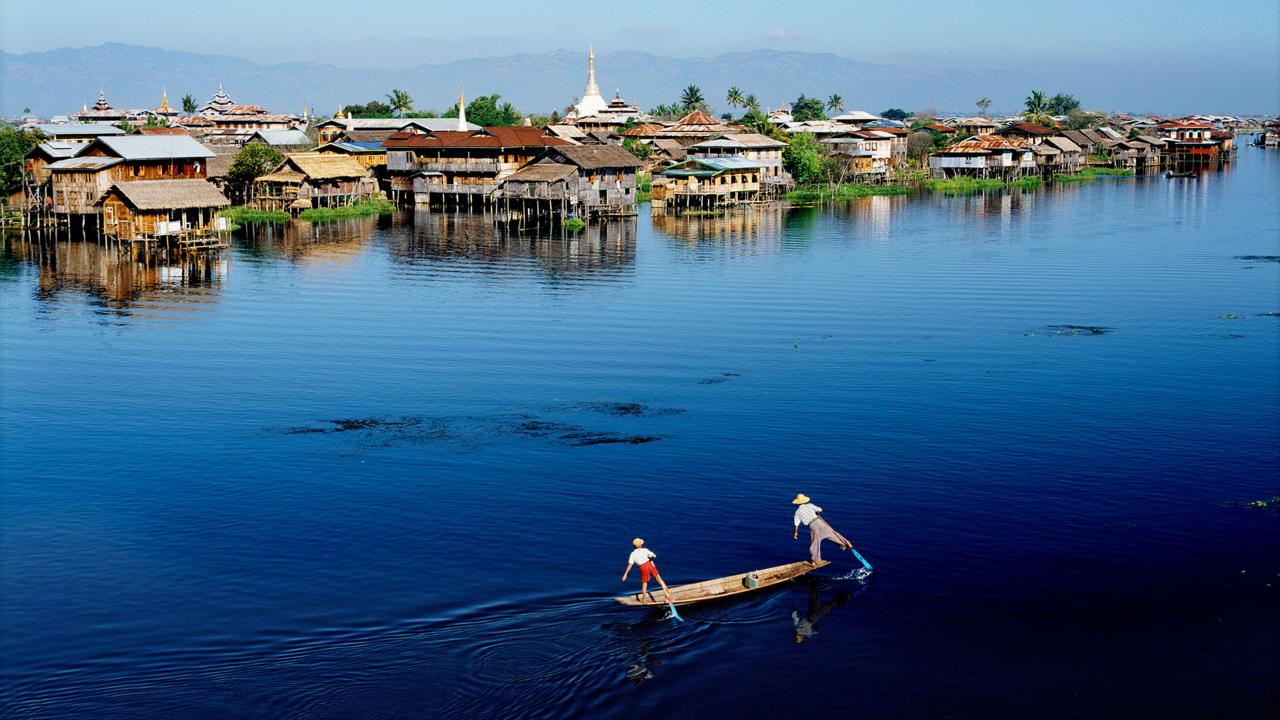
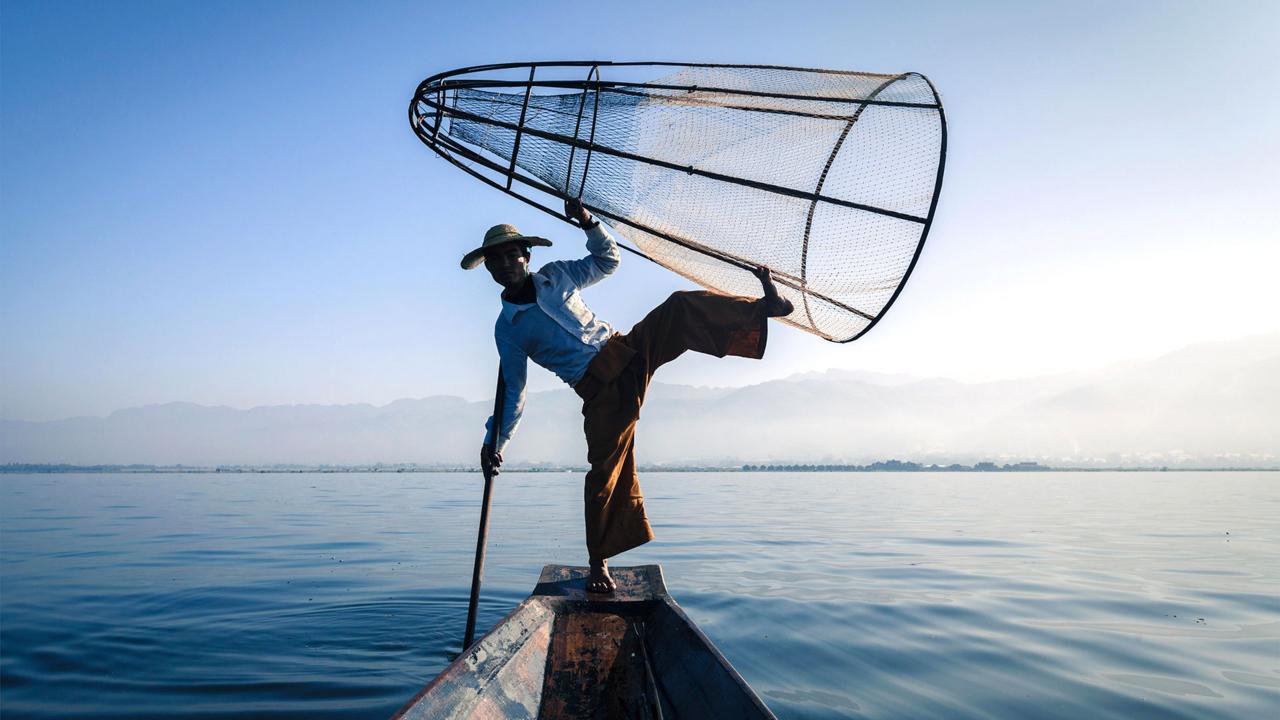
I was in a sky blue motorboat traversing Myanmar’s peaceful Inle Lake – the second largest in the country. Surrounded by mountains and clusters of colourful floating homes, I became mesmerised as the water swayed to the beat of the of the Intha fisherman, who expertly manoeuvred their tiny wooden boats by rowing with one leg.

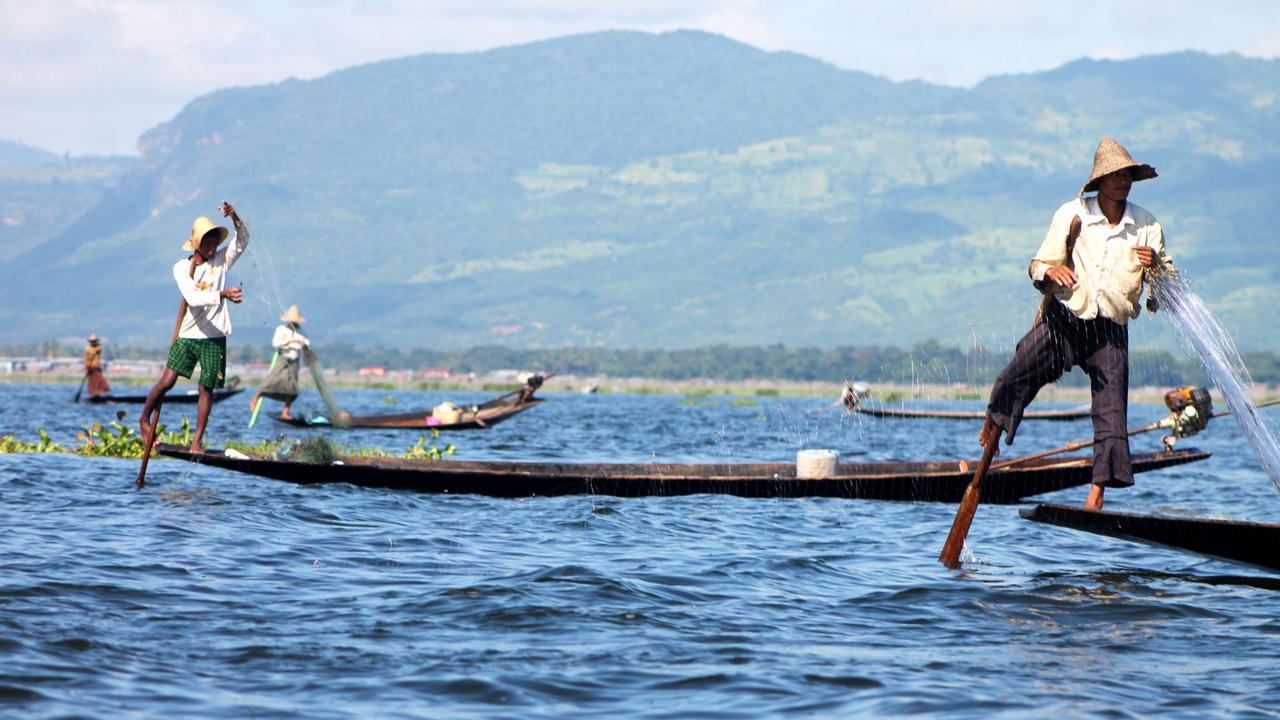
With meditative expressions, a group of three fishermen deftly rowed by while standing upright. Each had one leg wrapped around a single oar, leaving their sunburned hands free to manipulate the conical fishing nets they cast over the glistening water. This skill, unique to Inle Lake, takes a high level of balance, agility and strength. The fisherman have to determine the right amount of pressure to put on their free leg, while their other leg steers, turns and uses the oar to slow the boat down.

The rowers appear to have wooden legs from certain angles (Credit: Credit: Adrienne Jordan)
The rowers appear to have wooden legs from certain angles (Credit: Adrienne Jordan)
 “I tried many times to practice that distinctive rowing style but I always fell down into water.”
“One might think it is easy. I did!” laughed Nyein Moe, my local guide during a trip with Trafalgar tours. “I tried many times to practice that distinctive rowing style but I always fell down into water.”

As we passed through the floating community, the fishermen used the small boats to transport themselves around. They went to the floating markets and to pay their neighbours a visit by rowing from house to house. Not one had fallen into the water.

The fishermen travel in small canoe-like motorless boats (Credit: Credit: Blend Images/Alamy)
The fishermen travel in small canoe-like motorless boats (Credit: Blend Images/Alamy)
Around 200,000 people comprise Inle Lake’s Nyaung Shwe township, which includes various Myanmar ethnicities. However, the Intha or “lake people” make up the majority of the population. “The ‘In’ stands for lake and ‘tha’ means people in Burmese,” said Moe. The Intha community is self-sufficient when it comes to cultivating food and building materials.
“Their lives are dependent on this water.”
“Their lives are dependent on this water,” Moe explained, adding that they live on shore or in floating homes and flourish by fishing and cultivating arable rice paddies on the river’s delta. They also build floating gardens to grow produce, piling weeds and compost on long poles fixed to the lake floor.

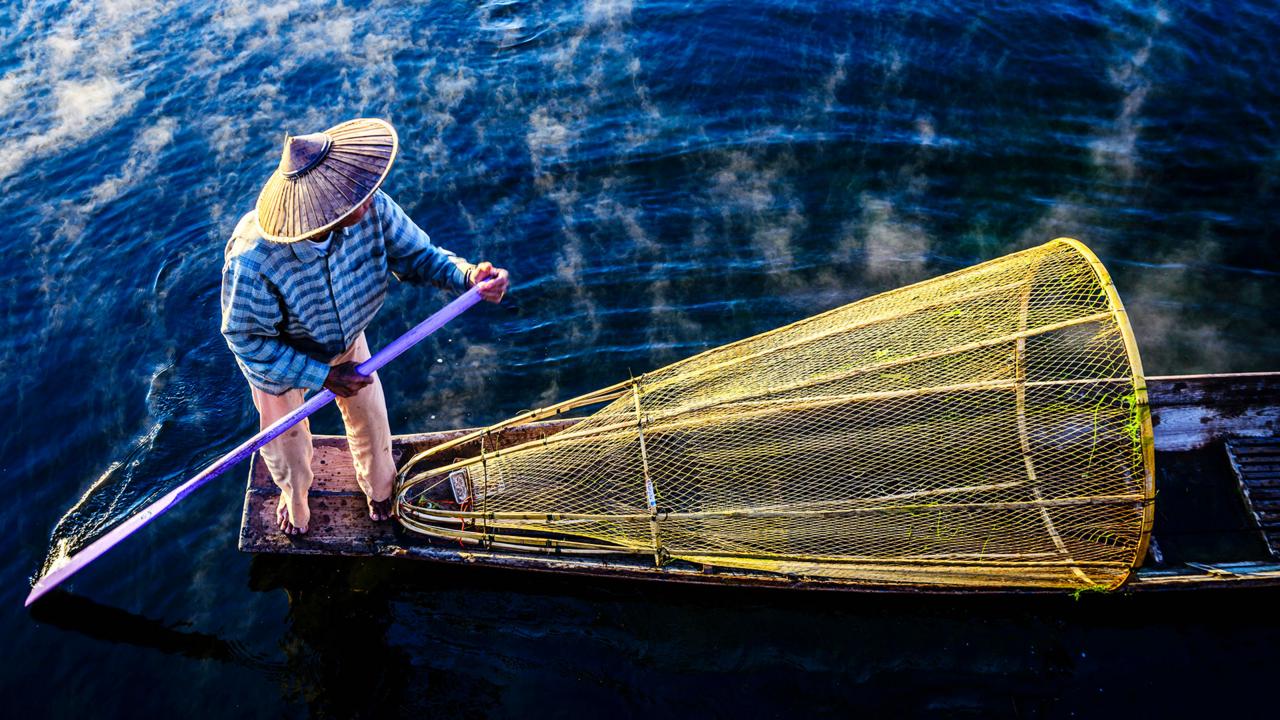
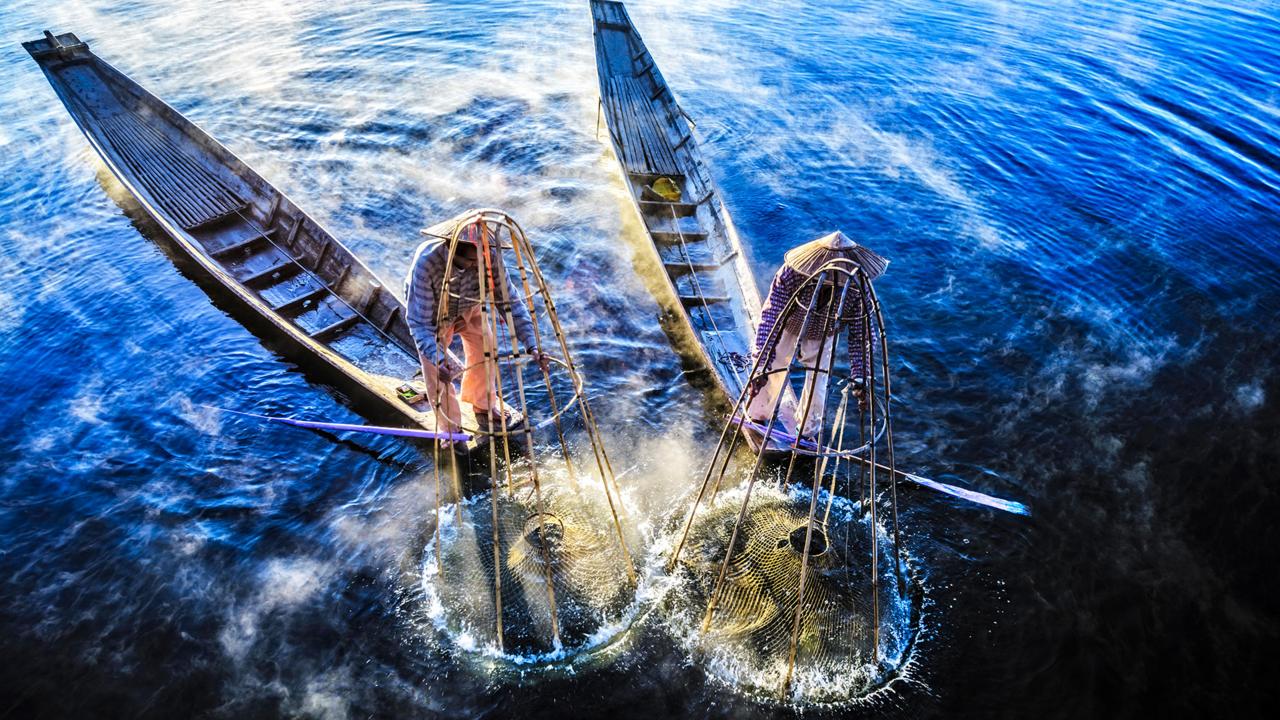
The fishermen snag their prey in massive baskets (Credit: Credit: Blend Images/Alamy)
The fishermen snag their prey in massive baskets (Credit: Blend Images/Alamy)
While believed to date back to the 12th Century, the exact origins of this one-legged rowing practice are still a mystery. However, as I witnessed this spectacular skill in person, I realized that it has likely survived for hundreds of generations because of its distinct advantages. The upright position allowed fisherman to see across the lake and spot dense hyacinth weeds just below the surface, where fish could be hiding. The fishermen were also able to keep close watch on bursts of bubbles created by shoals of fish. Ingenious, indeed.
The one-legged rowers exhibit masterful balance on the water (Credit: Credit: Dmitry Rukhlenko/Alamy)
The one-legged rowers exhibit masterful balance on the water (Credit: Dmitry Rukhlenko/Alamy)

BBC's Travel Show sent Rajan Datar to get a first-hand look at the one-legged rowers and the floating gardens of Inle Lake. The Travel Show brings you the latest insider travel news, a wealth of destinations, amazing experiences and features and practical hints, tips and advice for your holidays.
....................................................................................................

What do we know about Kim Jong Un?

– Kenji Fujimoto came prepared with a page of handwritten notes about North Korea's nuclear test the previous day. His conclusion: Kim Jong Un’s top priority is to improve the economy, so he needed to advertise his country’s technology to potential customers like Iran.

This kind of analysis is Fujimoto’s stock in trade these days. After all, he’s one of the few non-Koreans to have ever met Kim, and one of an even more select group that has talked to him since he became the leader of North Korea four years ago.

Never mind that Fujimoto spent only one boozy lunch with the “Great Successor” in 2012, or that most of the time they spent together was in the 1990s, when Fujimoto served as sushi chef to the current leader’s father, Kim Jong Il.

So little is known about the third-generation leader of North Korea that even this amount of contact qualifies Fujimoto for a unique job: professional Kimjongunologist.

“There’s no one else in Japan. I am the only one,” Fujimoto, who is 68 and uses a pseudonym, said in an interview. “This is all secret and I am revealing all my secrets to the world. For that, I can be executed by firing squad anytime.”

Fujimoto is the sole Japanese person known to have met Kim. (The only Americans believed to have met him are basketball player Dennis Rodman and his entourage). As such, Fujimoto has been in hot demand . On one side of his business card is the cover of his latest book, showing a photo of him hugging Kim Jong Un. The reverse: “Kim Jong Il’s chef. Please call this number below if you want to talk.”

Japanese television pays him $1,000 a pop to appear on screen talking about the North Korean leader, and newspapers — from Japan and around the world — give him about half that, he said. (The Post declined Fujimoto’s request for payment, instead conducting two interviews over lunch in a grimy Chinese restaurant he frequents.)

Governments also pay him for his insights, Fujimoto said, although he was hazy about the details. South Korea? Same as television, he said. The United States? “Probably.” U.S. diplomatic cables from 2008 released by Wikileaks said Japanese government analysts had “closely studied” Fujimoto’s first book. But the former chef denied rumors that Japanese authorities have paid him large amounts of money over the years.

Fujimoto is unique both in experience and in character.
Although he says he fears for his life and wears a bulletproof vest when he leaves this quiet town, he is instantly recognizable. In addition to his unusual bandanna and purple-tinted glasses, he wears a diamond-encrusted watch so flashy it would make a rapper blush, and he drives a silver sports car in a place filled with sensible hatchbacks.

In 1982, with a young family and struggling to make ends meet, Fujimoto responded to an advertisement seeking a sushi chef to work in North Korea. He ended up preparing fish for Kim Jong Il and became a “playmate” for Kim Jong Un, who Fujimoto says was born in 1983, and his older brother.

Then followed years of ad­ven­ture, he says — jet-skiing and motorbiking with the “Dear Leader” and flying around the world to buy caviar and cognac for him — as well as constant fear that he would run afoul of the system and be killed for it.
After he escaped from North Korea in 2001 during a run to Tokyo to buy sea urchin, Fujimoto wrote a book called “I Was Kim Jong Il’s Chef,” which became fodder for countless stories on the leader’s legendary gluttony. Finding himself suddenly in demand, Fujimoto wrote two more books and made frequent appearances on television.

Some people have doubted his expertise, and many of his tales are not consistent: In an interview Thursday, he denied that, while detained during one of his shopping trips to Tokyo, the Japanese government had made him read books about North Korea’s human rights abuses. Fujimoto had written about that in one of his books.

But he gained a lot of credibility when he predicted that Kim Jong Un would be named heir to Kim Jong ll. The received wisdom at the time was that Kim Jong Chol, the middle son, would inherit the leadership of the communist nation.

When Kim Jong Un was anointed in 2010, Fujimoto said, he was asked by people outside North Korea to share his prior experiences with the new leader. He recounted how, as an 8-year-old, Kim had tried to burst in on him while he was on the toilet, and how, when Kim was 17 and was back from school in Switzerland, he borrowed the Japanese chef’s Whitney Houston CD.

The whole time Fujimoto recycled these stories, though, he lived in fear of being knocked off by a North Korean agent, he said. Then in 2012, while he was at the store in this town northeast of Tokyo, he saw a tall man he recognized as North Korean. “I thought: ‘They've finally come for me’,” Fujimoto said.
“When the doors opened slowly, the first person I saw was Kim Jong Un, who said ‘Long time, no see, Fujimoto-san,’ ” he said of the reunion. That’s when he knew he was going to be fine, he said. As a child, Kim had never used the Japanese honorific on Fujimoto’s name.
Fujimoto defends regime that has few defenders
In the interview, Fujimoto pulled out photos from that meeting with Kim. One shows Fujimoto dabbing his nose with a handkerchief as he sits next to Jang Song Taek, the uncle that Kim would have executed in 2013. Another depicts Fujimoto wiping his eyes as he bows in front of Kim.

“I said to Kim Jong Un in Korean: ‘I, Fujimoto the betrayer, have now come back,’ and he said ‘It’s okay, it’s okay,’ as he tapped on my shoulder,” Fujimoto recalled. “I cried so hard.”
He wrote a book about this experience too, called “Broken Promise. A full confession to the Comrade General.” That’s the one that features a photo of the two hugging on the cover.

Across a table of shrimp, jellyfish and pork dishes, Fujimoto started to cry as he told the story of their meeting, which he said stretched over several hours and involved lots of wine and soju, a Korean liquor. “I’m not sad, I’m happy talking about my conversations with Kim Jong-un,” Fujimoto explained. “I have known him since he was 7.”

It is surprising that Fujimoto still feels so warmly about Kim and his regime, given that it sent Fujimoto’s North Korean wife, once a famous singer, and their two children to a coal mine for six years of hard labor after he had fled in 2001. He met his wife and daughter, now apparently rehabilitated and living in Pyongyang, during his visit in 2012. But he was told that their healthy, 22-year-old son — named Jong Un, which Fujimoto said was entirely a coincidence — had died of a heart attack a few weeks before his visit.

Nonetheless, Fujimoto seems to view it as his calling to defend a regime that has few defenders. He waves away questions about the government’s well-documented brutalities and says he continues to write letters to the “comrade general.” Still, Fujimoto has not been able to get another visa to return to Pyongyang.
This could pose a problem for his business model. He enjoys eating and drinking — he put away two bottles of beer at each lunch — and often goes to hot springs while he waits for reporters or intelligence services to call for fresh insights.

“The weekly papers might call,” he said at lunch on Thursday, after more than 24 hours without a call following the nuclear test.
Then he got into his little silver car and headed off to write a letter to Kim Jong Un wishing him a happy birthday. North Korea’s supreme leader turned 33 on Friday.

Yuki Oda and Kim Min-jung contributed this report.

วันอังคารที่ 5 มกราคม พ.ศ. 2559

Counting the tiger’s stripes


Counting the tiger’s stripes

S Ananthanarayanan
| 06 January, 2016

 Counting the tiger’s stripes

(Photo: SNS)
Evolutionary biologists have explanations for why animals have patterns on their coats or even birds on their wings, but the mechanism by which the patterns actually come about has not been understood. The legendary Alan Turing created a mathematical framework of how chemical interactions could lead to the periodic expression of growth factors, but it took many decades before the possible substances involved could be identified.
The patterns on the coats or animals are a familiar sight and clearly help them blend with the surroundings — for concealment, for safety or for greater stealth in the hunt. It is not difficult to understand that the chance appearance of features like the stripes on the tiger or the zebra or the spots on the leopard would have conferred a survival advantage, and genes that made for these features soon became the rule for the species.
But genes lead to particular proteins and tissue types, so how do colours get distributed? How, in fact, does tissue grow in specific shapes and how do patterns, or even limbs, grow in specific directions?
In a celebrated 1951-52 paper, Turing considered a simplified case of just a few cells and how chemical agents within the cells may interact and diffuse from one cell to another. He considered, first, a case of just two cells and, then, a case of a ring of cells, where agents that he called morphogens, or generators of form, would interact and then diffuse from cell to cell at different speeds, reinforcing or cancelling their effects at different places. He simplified the case to be studied so that the mathematics of the way mechanical or electrical disturbances spread could be applied to the progress of morphogens and he found that the effects of the chemical agents manifested in waves, with crests and troughs, just like waves in a vibrating string or electromagnetic waves.
The theory, when applied to the animal called the hydra, a simple, tubular creature that has a ring of tentacles at one end, led naturally to the  regularly spaced concentration of morphogens in the ring that forms an end of the hydra, to give rise to the ring of tentacles. Although without speaking of what the morphogens may be, Turing’s theory of “reaction and diffusion” was able to explain the black and white patches on Friesian cows, which he was interested in. The theory was carried forward by others and the stripes that appear on the back of the tiger are now understood as a pattern of pigmentation laid down by periodic waves of diffusion of chemicals in the animal’s embryo.
More complex patterns appear by considering more sets of waves. Just as one set of waves can lead to a stripe pattern, like the waves at the seaside, two sets of waves that cross each other would lead to a distribution of points or peaks, leading to a spotted pattern, like the coat of the leopard. The wave pattern is seen to be affected by different factors that include the dimensions of the area in which they occur, which determine the “boundary conditions”. This, in turn, leads to more conclusions about the spots or stripes on the tails of the great cats. The tiger has stripes on its body and tail and the leopard has spots on the body and the tail.
The cheetah has spots on the body and stripes on the tail, but no animal has spots on the tail and stripes on the body.  The reason seems to be the space available for two sets of waves, which lead to spots. If these could exist in the tail, for a spotted one, then they can certainly exist in the body, and the body must be spotted, rather than striped!
Recent studies of the ridges on the roof of the mouth of the common mouse have now identified a hormone called Fibroblast Growth Factor and a protein called Sonic Hedgehog as the chemicals involved. Other studies of the shapes of the cactus plant and the role of a hormone called auxin, by Allen Newel at the University of Arizona, have found that three sets of waves could be the reason for cells to grow in particular shapes. Tom W Hiscock and Sean G Megason at Harvard University note that there can be other drivers, besides the Turing process, of periodic phenomena, like cell-based mechanisms or mechanical properties, like elasticity, of a system. They have just published in the journal Cell Systems an integration of the different models in the form of a combined mathematical formulation to find bases for more features. Why the stripes of the tiger are vertical, while those of the zebra can be both ways, for example, or and even why the fingers grow along the length of the arm and not any other way.
The work of Newel, in fact, connects the waves of morphogens with some fascinating numbers that are found to appear in the plant kingdom. The Fibonacci series is a list of numbers where each is formed by adding the previous two, like this: 0, 1, 1, 2, 3, 5, 8, 13, 21, 34, 55, 89, 144… The interesting property of this series is that ratio of each pair of successive numbers gets closer and closer to 1.61803398874… the so called Golden Ratio, which appears in geometry, aesthetics, music, art and architecture. The ratio of successive numbers in the Fibonacci series, in fact, gets closer and closer to an infinitely long, non-repeating decimal number that actually cannot be expressed exactly as a ratio of two integers (and is hence known as an “irrational number”).
Series: 0 1 1 2 3 5 8 13 21 34 89  Ratio:  0 1 2 1.5 1.666 1.6 1.625 1.615 1.619 1.618  Fibonacci numbers are also found to appear everywhere in nature. One typical instance is the placement of leaves along the stalk of a plant. The angular separation of the leaves, as one goes up the stalk, is found to form a Fibonacci series. The fact that the ratio of successive numbers in the series tends to be an irrational number has an important consequence — that no leaf in the plant will ever find itself exactly above or below another leaf. This property accurately optimises the function of the leaves to receive the best of sunlight or rainfall, to make for the energy efficiency of natural systems to have evolved to be at the maximum that is possible.
While natural selection can explain how plants, and even snail shells, seashells, and a host of natural shapes have selected the most efficient and economical dimensions, the question always arises of how do species ensure that they grow according to these dimensions. The work of Newel and colleagues provides an illuminating lead — they find that the waves of the three morphogens involved in the cactus plant are connected by the Golden Ratio; the number of wave crests of the third wave is actually the sum of the numbers in the first two waves!
...................................................................................................................................................

วันเสาร์ที่ 2 มกราคม พ.ศ. 2559

The loneliest whale in the world

For years a mysterious whale with a unique song was tracked in the Pacific Ocean. Is it still out there? And is it really alone?
A blue whale (Balaenoptera musculus) at the surface (Credit: Wildlife GmbH/Alamy)
It's been nicknamed "the loneliest whale in the world". It sings a song like no other. Some say it wanders alone across the Pacific Ocean, crying out for companionship that never comes.
No-one knows for sure whether the whale is male or female, what species it is, or even if it still lives. The last in the original series of recordings was made in 2004.
It's one of the animal kingdom's great mysteries. But we might have been thinking about it the wrong way.
Maybe its unusual song doesn't isolate it after all. Perhaps instead it sings this way to ensure it can be better heard by its companions, or to impress members of the opposite sex. One way or another, this unusual whale can tell us a lot about whales and their songs.
Blue whales can sing for hours (Credit: Nature Production/NPL)
The story begins in 1989. An array of hydrophones called SOSUS, built by the US Navy to detect enemy submarines, picked up some strange signals. They were whale songs, and they were similar to blue whale calls, but there was one big difference.
His findings would be discussed for years to come
The key notes of the song were at a frequency of 52 Hertz. To human ears this is a low bass note, but it is significantly higher than the blue whale, which sings between 10 and 40Hz.
Fin whales also seemed like an unlikely fit, since they sing at 20Hz.
It was Bill Watkins, a marine mammal researcher at the Woods Hole Oceanographic Institution (WHOI) in Massachusetts, who first realised the significance of the Navy's recordings. For Watkins, tracking the 52Hz whale became a passion.
He passed away in 2004, aged 78, but a few months before his death he completed work on a paper that summarised 12 years' worth of recordings. His findings would be discussed for years to come. Watkins had found that the 52Hz whale was not just unusual, but outright unique.
A fin whale (Balaenoptera physalus) blowing (Credit: Mark Carwardine/NPL)
"It is perhaps difficult to accept that if this was a whale, that there could have been only one of this kind in this large oceanic expanse," Watkins and his colleagues wrote. "Yet in spite of comprehensive careful monitoring year-round, only one call with these characteristics has been found anywhere, and there has been only one source each season."
The popular press decided that it was the story of a lonely animal
The finding had all the hallmarks of a great mystery story. There was the renowned and dedicated scientist, the years of collaboration on classified military recordings, and the eventual publication of those findings when the material was declassified.
The popular press decided that it was the story of a lonely animal. In 2013, the Express, a British tabloid newspaper, claimed that the whale's unusual call had "stopped him finding love".
Now, American filmmaker Josh Zeman and actor Adrian Grenier are planning a crowd-funded documentary about the whale.
We still have much to learn about blue whales (Credit: Mark Carwardine/NPL)
The film's Kickstarter page strongly emphasises the idea that "52" is a lonesome beast. "The loneliest whale needs some friends," asserts a poster image encouraging donations. In the end, one of those would-be friends was Leonardo DiCaprio, whose foundation gave $50,000 and helped the campaign hit its $300,000 funding target.
It will be like looking for a needle in the world's largest haystack
The funds gathered will be used to mount an expedition in autumn 2015 in which, it is hoped, the 52Hz whale will be found and filmed. Zeman says the rest of the movie's budget will come from elsewhere.
His biggest challenge will be finding the correct whale and filming it. Calls at this loud, low frequency can travel hundreds and sometimes thousands of miles from their source. It will be like looking for a needle in the world's largest haystack.
But Zeman has another problem. Some whale scientists have questioned his whole approach.
It is a big ocean in which to find one whale (Credit: Aflo/NPL)
One critic is Christopher Willes Clark of Cornell University in Ithaca, New York. He made recordings of the 52Hz whale in 1993 and says it's not quite as anomalous as it might seem.
To ask if the whale is lonely – I don't think that's so far off the mark
Many types of idiosyncratic whale calls have been detected, and some studies suggest that groups of whales living in particular regions have dialects. When you consider that, the 52Hz whale is "not completely mind-bogglingly unique," he says.
Furthermore, Clark and others reject the idea held by some that the 52Hz whale cannot be heard or understood by "normal" blue whales that make lower-frequency calls. "The animal's singing with a lot of the same features of a typical blue whale song," he says. "Blue whales, fin whales and humpback whales: all these whales can hear this guy, they're not deaf. He's just odd."
"It's been a real struggle," admits Zeman, who has disagreed with some over the nature of the 52Hz whale's experience. "Definitely we speak in hyperbole. Is he the loneliest whale? But to ask if the whale is lonely – I don't think that's so far off the mark. My goal is to ask scientists to really consider this."
Blue whales have been changing their calls for decades (Credit: Mark Carwardine/NPL)
Complicating the picture further, the whale hasn't been calling at 52Hz for many years, according to John Hildebrand of the Scripps Institution of Oceanography in California. Watkins also noticed this. The whale's call has been gradually deepening and is expected to be closer to 47Hz today, though it’s been a few years since any recordings were identified.
Nobody knows why whales change their calls
It's not alone. Blue whales around the world have been singing at steadily deeper pitches since the 1960s, according to a study Hildebrand published in 2009. This suggests some kind of relationship between the 52Hz whale and blue whales. North Atlantic right whales for example are different – their calls have actually been rising in tone over time.
Nobody knows why whales change their calls like this. In 2009, Hildebrand and his colleague Mark McDonald suggested that blue whales were deepening their calls to make them stand out against shipping noise, which threatens to drown them out.
But that looks wrong, says Hildebrand. "It turns out that, by deepening the pitch of the song, the whales are actually shifting into an area where there's more noise, not less."
A seismic exploration ship (Credit: National Geographic Image Collection/Alamy)
Whales respond to man-made noise in an unpredictable way, says Clark. He has watched what happens when an oil and gas exploration ship approaches singing whales and sets off explosives to discover fossil fuel deposits beneath the seabed.
Every season they listen to each other and synchronise their songs
Sometimes the whales' response is dramatic. "In many cases the whales will change their whole behaviour," says Clark. "Males will stop singing, there'll be a quieting of the whole acoustic scene, they'll move out of the whole area." But not always. "At other times it won't make any difference."
Maybe the whales are changing their songs for another reason entirely. Hildebrand suggests that blue whales are competing with each other to be deeper, season after season.
"If the guy next to you is signing a little deeper than you, you better move down to synchronise," he says. "We see this. Every season they listen to each other and synchronise their songs."
That raises another question. If whales prefer to sing similar songs, what would make one of them sing at a completely different pitch?
Species like fin whales must now coexist with ships (Credit: Robin Chittenden/NPL)
The leading hypothesis is that the 52Hz whale is a hybrid, the offspring of two whales of different species. Such a whale would have an unusual body, and that might well affect its song.
Nobody has managed to record a hybrid whale's calls
Hybrids of fin whales and blue whales are well-documented and can be identified, according to John Calambokidis of the non-profit organisation Cascadia Research in Olympia, Washington. For instance, their body shape is often similar to that of a fin whale, but with a larger snout and flippers like a blue whale.
Certainly the 52Hz whale behaves a lot like a blue whale, says Kate Stafford of the University of Washington in Seattle. "It had the exact same seasonality as blue whales and if you look at the migratory patterns that Bill and his colleagues found, it's the same thing," she says. "So I feel pretty confident that at least part of this animal is a blue whale."
But we cannot yet be sure. Nobody has managed to record a hybrid whale's calls – even Calambokidis, who got close enough to document their unique appearances. Getting them on tape will be crucial.
Fin whales are smaller than blue whales (Credit: Espen Bergersen/NPL)
Calambokidis is one of several scientists now working on ways to make it easier to study the calls of individual whales. One of the biggest problems has been figuring out which whale is calling when.
As the animal produces the call its whole body seems to vibrate
Scientists often fit whales with microphones to record their calls. But these sometimes pick up the calls of nearby whales as well. So Calambokidis and his colleagues have added accelerometers, just like the ones your smartphone uses to detect motion, to the microphones.
"As the animal produces the call its whole body seems to vibrate and the accelerometer picks up that signal," says team member Peter Tyack of the University of St Andrews in the UK. "It's by far the best way to pick up when an animal in a group is making a call." In a study published in 2014, they showed that they could now match tagged animals to instances of their singing.
And over at WHOI, where Watkins once worked, marine biologist Mark Baumgartner has helped to oversee the development of a listening system which can automatically analyse and digitally publish marine mammal sounds in near real-time.
Whales are inherently social animals (Credit: Ole Jorgen Liodden/NPL)
The apparatus includes a moored buoy off the coast of Massachusetts. An underwater microphone listens out for marine mammal calls and on-board software written by Baumgartner classifies the calls by species.
The signals are then transmitted via satellite to computers at WHOI, which quickly process the data and publish it on the web. "What you're seeing on the website is near real-time data," says Baumgartner. "The latest stuff is less than two hours old."
People often like to imagine that animals experience the same emotions we do
In theory, detection methods like this could pinpoint specific animals, if their call is distinctive enough. "You could use this technology to search for 52Hz," says Baumgartner. However, it would have to be installed where the mysterious whale has been detected in the past, such as off the west coast of the United States.
What they can't tell us is what is going on inside the whale's head. The 52Hz whale may feel lonely, as Zeman suggests, but it's equally possible that it doesn't. There's certainly no reason to assume it does.
The fact is, people often like to imagine that animals experience the same emotions we do. Whales are complex and mysterious creatures. The idea that one might be out there, experiencing something as quintessentially human as loneliness, makes the animal seem somehow closer to us. But it remains a fantasy until there is evidence for it.
The 52Hz whale was detected off Point Conception, California (Credit: Scott London/Alamy)
That evidence will only turn up if we can find the 52Hz whale again. "No one since Bill [Watkins] has really put any effort into trying to track it down," says Hildebrand. But his team has recently been on the case.
In 2010, sensors off the coast of California picked up whale calls with the same pattern as Watkins' recordings.
The recordings were discovered by an intern, after Hildebrand suggested they look for evidence of the 52Hz whale. "We found it on sensors no more than five or six miles from my office," says Hildebrand. "So I think it's accessible and we should be able to solve it."
Conceivably Hildebrand's team has found a group of hybrid whales
However, Hildebrand's data suggests there is now more than one animal singing at this unusually high pitch. "You could see it on two widely separated sensors at the same time, so that suggests it's not just a single animal," he says. "It may be multiple animals."
Conceivably Hildebrand's team has found a group of hybrid whales, all singing at the same special pitch. The 52Hz whale may be a member of this group that sometimes wanders off on its own. If that's true, there is a happy ending to this story: the whale is not all that lonely after all.
Finding concrete evidence won't be easy. But many, from filmmakers to whale researchers, are now on the lookout. To discover the true nature of the 52Hz whale, we can only wait – and listen.
Blue whale (Balaenoptera musculus) diving (Credit: Bluegreen Pictures/Alamy)

....................................................................